

Introduction: Why Automation Is Now Business-Critical for SMEs
In today’s competitive landscape, automation has become essential for small and medium enterprises (SMEs). It helps bridge the gap with larger companies by increasing efficiency, reducing costs, and enhancing agility. Once considered a “nice-to-have,” automation is now a strategic necessity—driven by labor shortages, rising operational expenses, and evolving customer expectations.
For SMEs, automation encompasses a broad range of solutions, including office and workflow automation to streamline administrative tasks, industrial and shop-floor automation to improve manufacturing processes, and data, AI, and analytics automation to make smarter business decisions. This guide explores the most effective SME automation solutions, key selection criteria, and a practical roadmap for successful implementation, empowering small and medium enterprises to thrive in a digital economy.
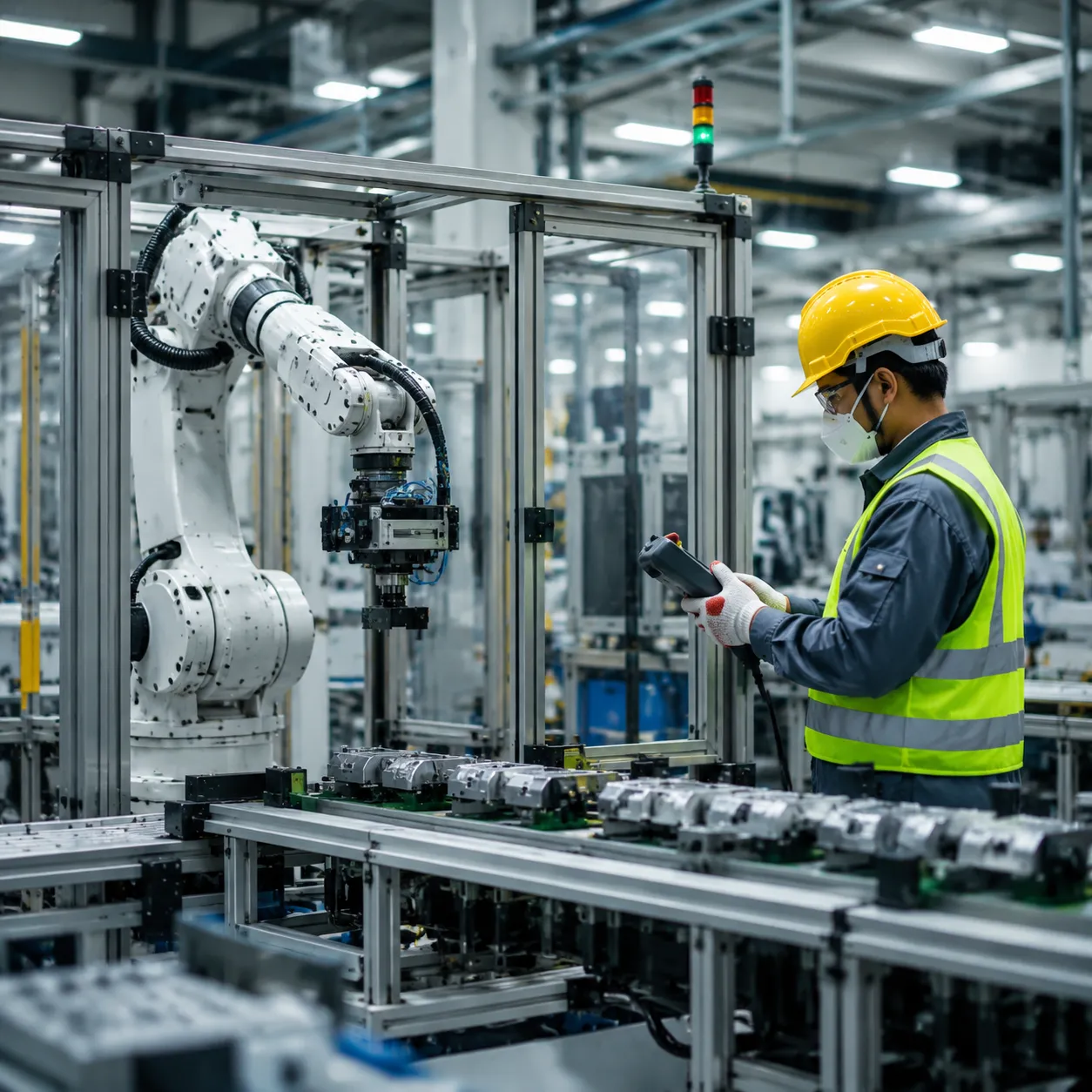
Understanding SME Automation: Key Concepts and Types
Automation in the SME context means streamlining repetitive tasks, orchestrating processes, and integrating cyber-physical systems to improve efficiency. Repetitive task automation handles routine activities like data entry or order processing, freeing up staff for higher-value work. Process and workflow orchestration coordinate multiple steps across departments, ensuring smoother operations. Cyber-physical and industrial automation involve controlling machinery and production lines through digital systems, essential for manufacturing SMEs aiming to boost productivity and quality.
Several types of automation are particularly relevant to small and medium enterprises. Business process automation (BPA) simplifies administrative workflows, while robotic process automation (RPA) handles back-office tasks such as invoice processing or data updates. Marketing and sales automation tools support lead nurturing, email campaigns, and customer engagement. Finance and HR automation streamline payroll, onboarding, and compliance tasks. Industrial automation—covering PLCs, SCADA systems, drives, and motion control—enhances manufacturing processes, making them more efficient and reliable. Additionally, AI-driven automation, including analytics, forecasting, anomaly detection, and chatbots, helps SMEs make smarter decisions and improve customer interactions.
Compared to large enterprises, SME automation must account for tighter budgets, limited resources, and skills gaps. This means solutions need to be simpler, modular, and scalable, allowing small businesses to start small and expand as they grow. The focus is on affordable, easy-to-implement systems that deliver quick wins and measurable ROI, making automation accessible and practical for SMEs without the need for extensive technical expertise.
How to Evaluate Automation Solutions for SMEs
Aligning automation with your business goals is essential. Focus on solutions that help reduce manual work and error rates, which directly improve efficiency. Shortening lead times and boosting delivery reliability are also key benefits. Additionally, automation should increase your capacity and scalability without requiring proportional hiring, supporting your growth plans.
When selecting SME automation solutions, consider core criteria such as ease of use—preferably no-code or low-code platforms with intuitive interfaces—making implementation accessible even with limited technical resources. Seamless integration with existing systems like ERP, CRM, and MES is critical; open APIs and connectors facilitate this. Scalability and modularity matter too, allowing you to start small and expand as needed.
Total cost of ownership, including licensing, hardware, integration, and ongoing maintenance, should fit your budget. Security, compliance, and data governance are non-negotiable to protect your operations. Vendor support, local partners, and a strong ecosystem ensure you can get help when needed and keep your automation solutions running smoothly.
Calculating ROI is vital for justifying automation investments. Identify measurable KPIs such as throughput, Overall Equipment Effectiveness (OEE), error rate, cycle time, and labor hours saved. Estimating the payback period and breakeven point helps you understand the financial impact. For small and medium enterprises, reviewing real-world ROI scenarios can guide smarter decisions and maximize your automation investment.
Best Office & Workflow Automation Solutions for SMEs
Workflow and task automation platforms are essential tools for small and medium enterprises looking to streamline operations. SMEs should consider implementing these solutions when aiming to reduce manual tasks, improve accuracy, and accelerate approval processes. Typical use cases include automating approvals, notifications, and document routing, which help keep workflows smooth and transparent.
Robotic Process Automation (RPA) plays a vital role in back-office tasks, offering a cost-effective way to handle repetitive activities. RPA is well-suited for tasks such as data entry, invoice processing, and updating ERP systems, freeing staff to focus on higher-value work. For example, integrating RPA with existing systems can significantly boost productivity and accuracy.
Document and data automation leverage technologies like OCR and intelligent document processing to handle invoices, orders, and contracts efficiently. Automating reporting and dashboards also provides real-time insights, enabling quicker decision-making. Seamless integration with enterprise systems—such as CRM, ERP, HR, and accounting—is crucial, and open APIs and connectors ensure these solutions work smoothly within existing IT environments.
Choosing the right office and workflow automation tools can drastically improve operational efficiency for SMEs, making daily tasks more manageable and reducing errors. For more advanced automation, exploring scalable solutions like Siemens’ automation platforms can provide the flexibility and integration needed for growth.
Best Marketing, Sales, and Customer Service Automation for SMEs
SME automation solutions work best when they save time without adding complexity. I focus on tools that help small and medium businesses stay organized, respond faster, and keep a clear view of every customer touchpoint.
Marketing Automation
- Use workflow and office automation tools to run email campaigns, lead nurturing, and audience segmentation with less manual work.
- Schedule social media posts and track performance so I can see what drives clicks, replies, and traffic.
- Keep messages consistent across channels so follow-up stays simple and repeatable.
Sales Automation
- Connect CRM workflows to opportunity tracking and automated follow-ups so no lead slips through the cracks.
- Automate quote generation and proposal steps to shorten response time.
- Use scalable automation for SMEs to keep sales activity moving even when the team is small.
Customer Service Automation
- Use chatbots and virtual assistants to handle common questions and basic support requests.
- Route tickets automatically, suggest knowledge base answers, and offer self-service portals to reduce wait time.
- Keep support handoffs clean so customers get faster, more consistent answers.
Metrics That Matter
- Lead conversion rate
- Customer acquisition cost
- Response time
- Retention
For me, the goal is simple: reduce manual work, improve response speed, and give the team more time to close business and support customers well.
Best Finance, HR, and Administration Automation for SMEs
Small business process automation works best when it takes pressure off the everyday work that slows teams down. I look for SME automation solutions that clean up finance, HR, and admin tasks without making the setup hard to manage. The goal is simple: fewer manual steps, fewer mistakes, and better control.
Finance and accounting automation
I focus on automation that gives me faster invoicing, steady payment reminders, and cleaner reconciliation. That also helps with expense management and cash flow visibility, which matters a lot when every dollar counts.
- Invoicing and payment reminders
- Reconciliation and expense tracking
- Clear cash flow reporting
- Less manual follow-up and fewer missed entries
HR and workforce automation
For HR, I want workflow and office automation tools that make onboarding, offboarding, and training easier to run. Time and attendance, shift planning, and payroll integration also save time and reduce back-and-forth for growing teams.
- Onboarding and offboarding workflows
- Training task tracking
- Time & attendance and shift planning
- Payroll-ready data flow
Compliance and risk control
I also look for automation that keeps records clean and auditable. Approval steps, document retention, and regulatory reporting help reduce risk and make daily operations easier to track.
- Audit trails for key actions
- Approval routing for sensitive tasks
- Document retention rules
- Better support for compliance and reporting
What I look for
For SME automation solutions, I keep it practical: affordable automation systems, simple setup, and scalable automation for SMEs that can grow with the business. The best tools remove friction, support better control, and make digital transformation for small and medium enterprises feel manageable.
Best Industrial Automation Solutions for Manufacturing SMEs
For me, industrial automation is no longer a nice extra for small and mid-sized manufacturers. If I want stronger output, steadier quality, better safety, and lower energy waste, I need a setup that does the repeatable work well and keeps people focused on higher-value tasks.
Why It Matters
- Productivity: reduce manual handoffs and keep the line moving.
- Quality: cut variation and catch problems earlier.
- Safety: move people away from repetitive or risky tasks.
- Energy efficiency: monitor usage and trim waste on the shop floor.
Core Building Blocks
- Sensors and field devices: collect the real-world data the process depends on.
- PLCs and controllers: run the machine logic and keep operations consistent.
- Drives, motors, and motion control: handle speed, positioning, and movement with precision.
- HMI/SCADA systems: give operators a clear view of the process, alarms, and status. A compact option like a SIMATIC HMI KP700 Comfort panel fits well when I need simple, reliable shop-floor visibility.
For control, a unit such as the Siemens SIMATIC S7-300 CPU 314 controller is the kind of PLC-based foundation I look for when I need stable machine control in a smaller footprint.
Modular and Scalable Setup
- Start with one machine or line: keep the first step focused and measurable.
- Expand in stages: add more lines, then plant-wide control, then multi-site visibility.
- Keep it modular: this makes scalable automation for SMEs easier to budget and easier to maintain.
Common SME Use Cases
- Repetitive assembly, packaging, and material handling
- Batch process control in food and beverage, chemicals, and pharmaceuticals
- Energy monitoring and optimization to track usage and reduce waste
| Need | Practical Fit |
|---|---|
| Faster output | PLC-based control and motion systems |
| Easier operation | HMI/SCADA with simple screens and alarms |
| Better oversight | Sensors, controllers, and plant data collection |
| Lower downtime risk | Clear diagnostics and lifecycle management |
Siemens Automation Approach
I look for Siemens automation for small business when I want a practical setup built around:
– PLC-based control
– Drives and motion control
– Integrated automation platforms
– Simplified engineering
– Lifecycle management that supports long-term use
That mix supports industrial automation for small manufacturers without forcing a full-scale overhaul on day one.
Industrial automation is no longer optional for small and medium-sized manufacturers aiming to stay competitive. Implementing scalable automation solutions helps improve productivity, ensure consistent quality, enhance safety, and reduce energy costs. Core building blocks such as sensors, PLCs, drives, and motion control are essential for modern SME production environments. Modular and scalable architectures allow SMEs to start with a single machine or process and expand gradually, aligning with growth and budget constraints. For example, batch process control in food, beverage, or pharmaceuticals benefits from flexible automation systems that can evolve over time. Siemens offers comprehensive automation platforms that support simplified engineering and lifecycle management, making industrial automation accessible and practical for small manufacturers seeking to optimize their operations.
Best Automation Solutions for Small and Medium Enterprises
Siemens automation for small business
I choose automation that solves real plant problems without making the setup heavy. For SME industrial control and monitoring, PLC-based control, drives, and integrated automation platforms give me a practical way to standardize machines, track performance, and scale step by step. This is a strong fit for industrial automation for small manufacturers that need affordable automation systems, not a complex rebuild.
- PLC-based control: stable machine logic and easier troubleshooting
- Drives and motion control: tighter control of speed, torque, and positioning
- Integrated automation platforms: simpler engineering across machines and lines
- Lifecycle management: easier updates, maintenance, and long-term support
Siemens Automation for Small Business
For industrial automation for small manufacturers, I look for systems that are simple to deploy, easy to expand, and solid enough for daily production. That usually means PLC-based control, drives, and integrated automation platforms that help me keep machines running, improve consistency, and manage change without adding extra complexity.
What I focus on
- PLC-based control for stable machine and line operation
- Drives and motion control for better speed, accuracy, and repeatability
- Integrated automation platforms to connect control, monitoring, and engineering in one setup
- Simplified engineering and lifecycle management to make upgrades, service, and long-term support easier
Why it matters
- Less manual work on repetitive production tasks
- Better visibility across equipment and processes
- Scalable automation for SMEs that can start with one machine and grow over time
- Practical fit for U.S. plants that need reliable performance, lower downtime, and a clear path to smart factory solutions
Siemens Automation for Small Business
For manufacturing SMEs, I keep the focus on what actually moves the line: PLC-based control, drives, motion control, and simple monitoring that can grow without a full plant overhaul. That is the practical side of understanding how a servo drive works when I am planning scalable automation for SMEs.
- Start with one machine, one cell, or one repeat process before expanding.
- Use integrated control and monitoring to cut manual checks and reduce downtime.
- Keep engineering simple so the team can support it without deep specialist overhead.
- Choose modular industrial automation for small manufacturers that fits future line growth.
- Build around lifecycle management so upgrades stay manageable over time.
For me, the best SME automation solutions are the ones that improve productivity, quality, and uptime without adding complexity.
Industrial automation is no longer optional for small and medium-sized manufacturers aiming to stay competitive. Implementing scalable automation solutions boosts productivity, enhances product quality, and improves safety while reducing energy consumption. Core building blocks like sensors, PLCs, drives, and HMI/SCADA systems form the foundation of effective SME automation. Starting with a single machine or process allows for incremental expansion—whether adding more lines or entire plants—without overwhelming resources. Practical use cases include automating repetitive assembly, packaging, and material handling tasks, as well as batch process control in industries like food, chemicals, and pharmaceuticals. Modular, scalable architectures enable SMEs to adopt automation gradually, aligning with their growth and budget constraints. Siemens offers a range of solutions—from PLC-based control to integrated automation platforms—that support SME manufacturing needs with simplified engineering and lifecycle management. For more details on selecting appropriate drives, visit servo drive selection.