
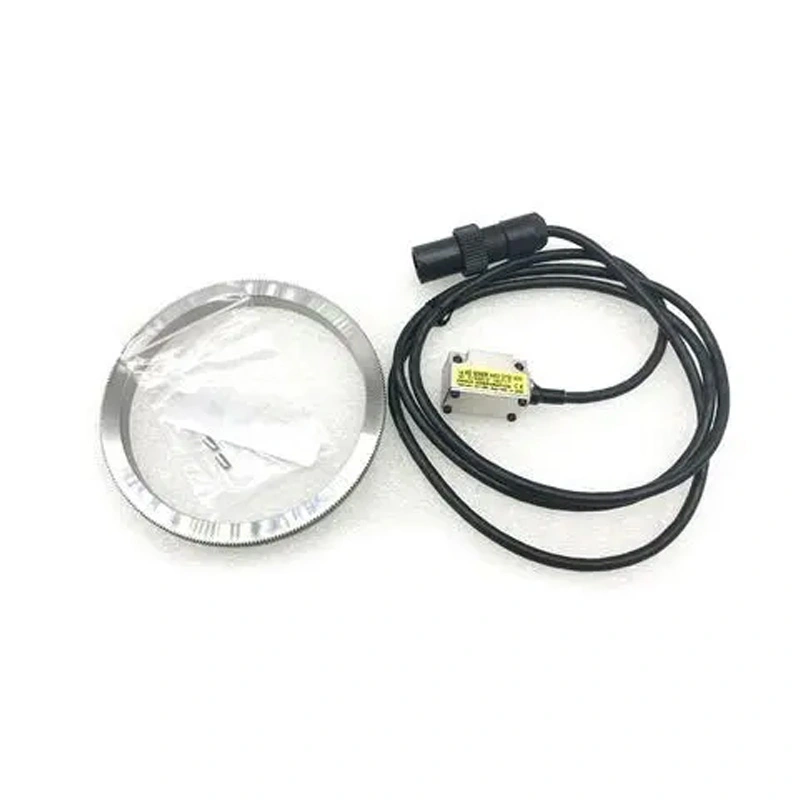
The A860‑2150‑V001 spindle encoder is designed for Fanuc αi and built‑in AC spindle‑motor platforms, where it mounts as a rotary sensor head (AIBZ/BZI sensor) on the spindle’s internal shaft or encoder ring and connects to the spindle amplifier via a dedicated servo‑type feedback cable. It is used in high‑speed machining centers, turning lathes, and grinding machines that require tight‑tolerance spindle‑position control, orientation, and indexing, as well as precise RPM regulation for complex CNC cycles. The unit is often sold as an AIBZ / αi BZ sensor head assembly, which integrates the magnetic or optical sensing element, housing, and connector in one compact module.
Technically, the A860‑2150‑V001 typically functions as an incremental spindle encoder producing quadrature A/B or sin‑cos signals referenced to the spindle’s magnetic or encoder‑ring feedback, with a 1 Vpp differential sine‑cosine output (on replacement‑style analog units) or digital pulse output matching Fanuc specifications. The sensor is powered at a low DC voltage (often around +5 V with strict ripple limits) and draws only a few tens of milliamps, making it suitable for long‑run operation inside sealed spindle heads. The integrated cable from the sensor head to the connector often includes shielded wiring (e.g., TPU‑insulated, ~1.2–2.1 m length) and a JN‑series or Fanuc‑style plug that mates directly with the spindle‑amp terminal, simplifying wiring and reducing noise‑related errors.
Mechanically, the A860‑2150‑V001 is a compact, flange‑mount sensor head that fits into the rear housing of the built‑in AC spindle motor, using a tapered or keyed shaft and flange mounting for secure alignment and trouble‑free rotation. Fanucworld describes it as a “BZI sensor head assembly” with tapered‑shaft (TPR), keyed shaft, and flange‑mount features to ensure smooth, vibration‑resistant operation under heavy‑cutting loads. Typical replacement‑spec spindles advertise this sensor as supporting sin‑cos 1 Vpp outputs up to about 200 kHz, temperature ranges such as –10 °C to +85 °C, and insulated, shielded cabling rated for continuous duty in oil‑mist and coolant‑laden CNC environments.