

2026 Automation Outlook
Manufacturers in the U.S. are under pressure from every direction: labor shortages, supply chain disruptions, tighter quality demands, and tougher sustainability goals. In 2026, the answer is no longer basic automation alone. It is predictive, connected, and increasingly autonomous systems that help plants adapt faster and operate with less waste.
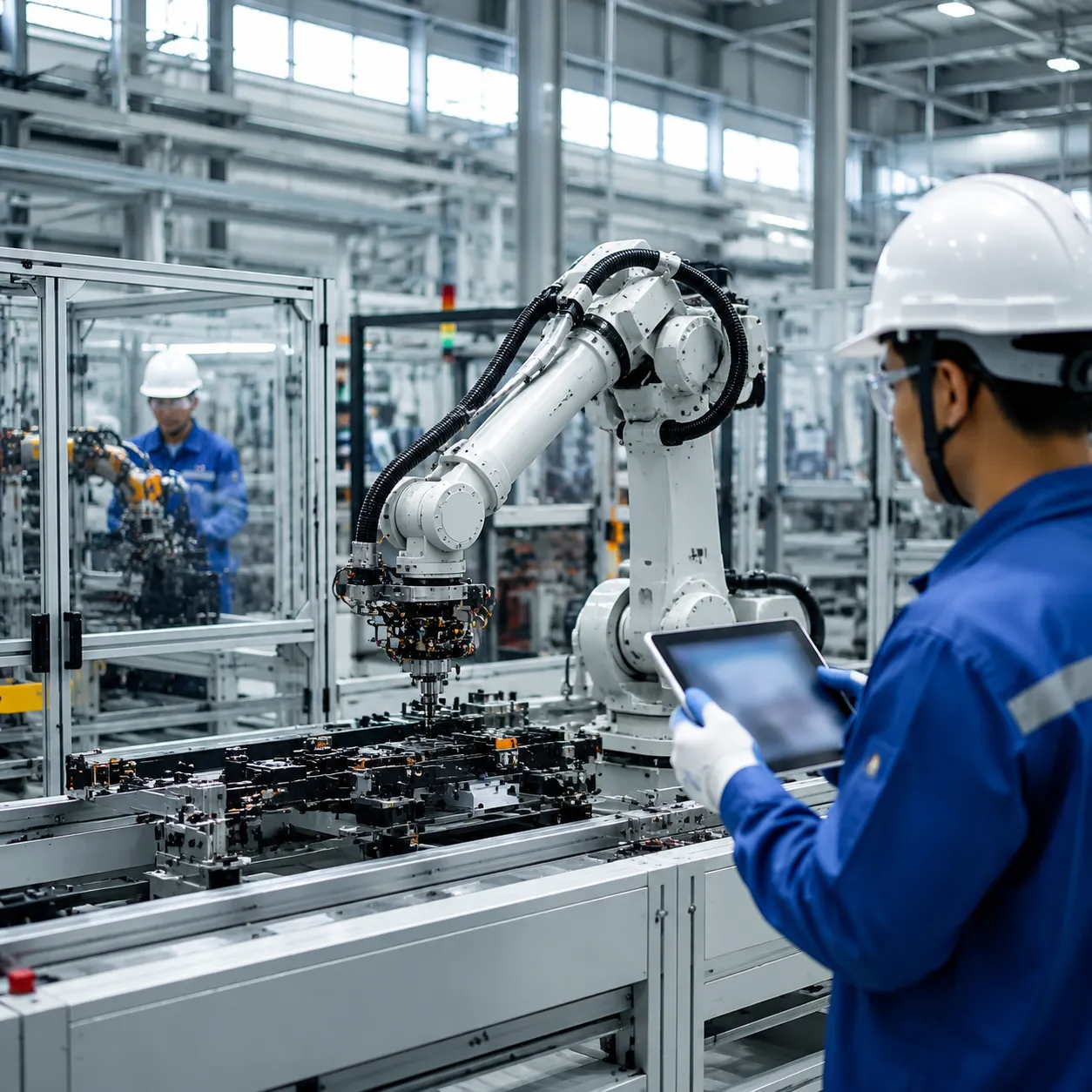
From Reactive to Predictive
Traditional automation is built to repeat a task. Modern automation is built to anticipate change.
- Predictive systems use data to spot issues before they stop production.
- Autonomous systems adjust workflows in real time with less manual intervention.
- Industrial Internet of Things (IIoT) connects machines, sensors, and software for better visibility across the line.
This shift helps teams move from firefighting to control, especially when talent is limited and uptime matters more than ever.
What Is Driving Change
The pressure to modernize is coming from practical business needs, not hype:
- Labor shortages are making it harder to run lines consistently.
- Supply chain disruptions are pushing plants to become more flexible.
- Sustainable industrial automation is now tied to energy use, waste reduction, and compliance.
- Legacy systems are creating gaps in data, speed, and reliability.
Why It Matters Now
The manufacturers gaining an edge are the ones using automation to make faster decisions, reduce downtime, and scale without adding complexity. Technologies like Digital Twin Technology, Edge Computing in Manufacturing, and AI Trust, Risk, and Security Management (AI TRiSM) are turning automation into a strategic advantage.
Siemens helps make that shift practical by connecting software, hardware, and data into a more resilient factory foundation. The result is simple: better performance, lower risk, and stronger competitiveness in 2026 and beyond.
Innovative Automation Technologies to Watch in 2026: The Intelligence Layer
I see the biggest shift in 2026 as moving from hard-coded controls to software-defined automation. That gives me faster changeovers, simpler scaling, and better use of Industrial Internet of Things (IIoT) data without adding more noise to the line.
Agentic AI
- Multiagent systems can break down tasks, make routine calls, and hand off exceptions only when needed.
- I like low-code AI interfaces because plant operators can work faster without heavy training.
- When the operator layer is unstable, I fix the basics first with a quick HMI and PLC no-response troubleshooting guide so the AI layer sits on solid controls.
AI TRiSM
- AI Trust, Risk, and Security Management (AI TRiSM) keeps AI outputs traceable, safe, and compliant.
- It helps me protect data privacy and line up AI decisions with Operational Technology (OT) Cybersecurity rules.
- That matters any time AI touches quality checks, maintenance, or safety actions.
Digital Twins
- Digital Twin Technology lets me test line changes, optimize settings, and spot bottlenecks before deployment.
- It cuts commissioning risk and supports Predictive Maintenance ROI.
- In practice, I get faster rollouts, fewer surprises, and a cleaner path to sustainable industrial automation.
Physical Layer: Robotics and Spatial AI
I focus on robots that solve real shop-floor problems: missed picks, slow moves, and too much manual handling. In U.S. plants, the win comes from Autonomous Mobile Robots (AMRs), 3D Machine Vision Systems, and Collaborative Robots (Cobots) that fit into existing lines without forcing a full rebuild.
Autonomous Mobile Robots (AMRs)
- AMRs use swarm intelligence to move parts, tools, and pallets with less traffic and fewer delays.
- They work well for collaborative material handling in mixed-production environments.
- When paired with a Siemens SIMATIC S7-300 CPU 314 standard controller, they can stay coordinated with conveyors, lifts, and safety systems.
3D Machine Vision and Edge AI
- 3D machine vision gives robots depth and shape awareness for harder jobs like bin-picking and random part sorting.
- Edge AI keeps inspection fast by processing images locally, which cuts latency and reduces cloud dependence.
- This setup improves quality checks, catches defects sooner, and supports tighter Predictive Maintenance ROI through better machine data.
Cognitive Cobots
- Cognitive cobots support Human-Machine Collaboration by adjusting to people, not forcing people to adapt to the robot.
- They are built for safe speed, quick redeployment, and real-time response in shared workspaces.
- For manufacturers balancing labor gaps and output goals, cobots offer a practical path to factory modernization without overcomplicating operations.
Edge Computing in Manufacturing
I treat the infrastructure layer as the part that keeps the plant fast, stable, and easier to secure. In Edge Computing in Manufacturing, local processing cuts cloud dependency, lowers latency, and keeps critical IIoT data close to the machine.
- I use decentralized edge processing to make real-time decisions on alarms, quality checks, and machine events without waiting on the cloud.
- For retrofit lines and distributed cells, a Siemens SIMATIC S7-300 CPU 314 standard controller gives me a practical base for local control and faster response.
- When I need a second proven control option for standardized automation, the Siemens SIMATIC S7-300 CPU 314 controller supports a flexible modernization path.
IO-Link Smart Sensors
The IO-Link Communication Protocol makes smart sensors easier to manage. I get better diagnostics, stronger condition monitoring, and cleaner interoperability across mixed equipment.
- Faster fault detection
- More accurate predictive maintenance ROI
- Easier setup for new and legacy devices
- Better visibility into sensor health and drift
OT Cybersecurity
I build Operational Technology (OT) Cybersecurity around zero-trust thinking: verify access, limit device permissions, and segment the network. That protects connected assets without slowing production.
- Stronger control over who can reach edge devices
- Less exposure from flat plant networks
- Better protection for factory data and machine uptime
- Safer scaling for connected automation systems
Practical Value
For me, this layer is where Sustainable Industrial Automation becomes real. Local compute, smart sensors, and tighter security make it easier to modernize without overbuilding the cloud stack or disrupting daily operations.
Sustainable Industrial Automation in 2026
I focus on upgrades that cut energy use without forcing a full plant rebuild. For most U.S. operations, Factory Retrofitting and Modernization is the faster move because it protects cash flow, reduces downtime, and supports Sustainable Industrial Automation.
Retrofitting vs. Greenfield
- Retrofitting legacy lines with smart sensors, IO-Link devices, and connected controllers gives quick wins in diagnostics, energy tracking, and Predictive Maintenance ROI.
- Greenfield builds make sense for major process changes, but most teams need a phased path that keeps production running.
- On older lines, I often start with a compact controller like a Siemens SIMATIC S7-300 compact PLC for medium automation to add control and data capture without a full overhaul.
AaaS for Smaller Plants
- Automation-as-a-Service (AaaS) lowers upfront cost and makes modernization easier for SMEs.
- It shifts part of the spend from CapEx to OpEx, which helps teams scale upgrades in stages instead of waiting for a big budget cycle.
- For modular expansion, a flexible controller like a Mitsubishi FX5UJ PLC programming controller fits well in step-by-step retrofit projects.
What Matters Most
- Use smart sensors, local control, and Edge Computing in Manufacturing to reduce waste and improve response time.
- Build around energy efficiency, uptime, and data visibility.
- Keep the plan practical: modernize the line, control risk, and make every upgrade earn its place.
Implementation Strategies: Siemens as a Partner for 2026
Partnering with Siemens provides a clear path to adopting innovative automation technologies that ensure your factory remains competitive in 2026. Integrating Siemens Xcelerator, a comprehensive industrial software platform, with edge devices and automation hardware creates a seamless, scalable ecosystem. This setup supports flexible manufacturing, allowing quick adjustments to changing demands and rapid deployment of new processes.
Building a future-proof factory involves retrofitting legacy systems with smart sensors and controllers or designing greenfield facilities optimized for energy efficiency and automation. Siemens solutions simplify this transition, reducing costs and minimizing downtime. Leveraging automation-as-a-service (AaaS) models makes advanced technology accessible for small and medium-sized enterprises, balancing capital expenditures with operational costs.
Measuring ROI through predictive maintenance, downtime reduction, and labor optimization is critical. Implementing advanced analytics and digital twin technology enables real-time insights, helping managers make data-driven decisions that maximize efficiency. Siemens’ integrated approach ensures your manufacturing operation stays agile, secure, and ready for the demands of Industry 4.0 and beyond.
Conclusion & Next Steps
Adopting autonomous, secure, and scalable automation isn’t just a choice—it’s a necessity in 2026. Industries that delay risk falling behind, facing obsolescence as competitors leverage advanced technologies like AI-driven workflows, digital twins, and edge computing to gain a decisive edge. Staying ahead means embracing innovation now, not later.
Practical next steps include reviewing your current systems through comprehensive whitepapers and operational audits. Engaging with experts in industrial automation can reveal hidden inefficiencies and unlock new ROI opportunities, especially in predictive maintenance and labor optimization. Partnering with trusted providers like Siemens ensures your factory ecosystem remains flexible, future-proof, and aligned with sustainability goals. Moving swiftly to implement these strategies will secure your manufacturing competitiveness well into the future.