

Are you trying to decide between the A06B-6117-H106 and A06B-6117-H109 FANUC power supply modules? Choosing the right module can make all the difference in your CNC system’s performance, reliability, and longevity. While they may look similar, subtle differences in specifications, build quality, and application suitability can impact your automation setup. In this comparison, I’ll break down the key differences and considerations so you can make an informed choice—whether you’re upgrading, replacing, or just ensuring optimal system performance. Let’s dive into the details.
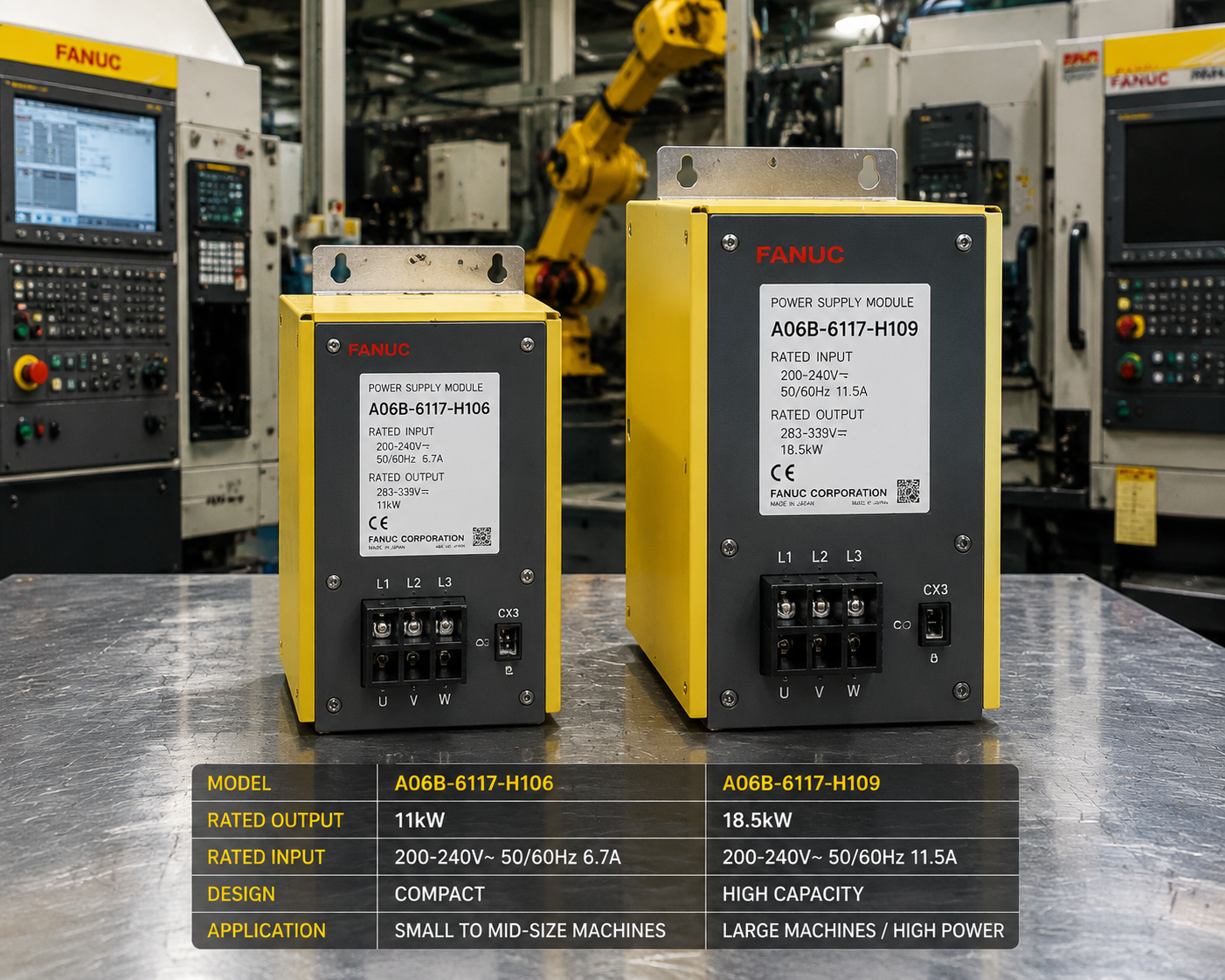
Overview of FANUC Power Supply Modules
Have you ever wondered what keeps your CNC machine running smoothly? The answer lies in the power supply module, a crucial component that powers the entire system. FANUC power supply modules, like the A06B-6117-H106 and A06B-6117-H109, are designed to deliver reliable, stable power to CNC systems, ensuring consistent performance and minimal downtime.
Role in CNC Systems
FANUC power supply modules act as the heart of your CNC machine’s electrical setup. They convert standard AC power into the stable DC power needed for controllers and servo drives. Without these modules, your CNC machine wouldn’t operate efficiently or reliably. They’re essential for:
- Maintaining continuous operation
- Protecting sensitive electronics
- Ensuring stable voltage delivery
Key Features and Benefits
When choosing a FANUC power supply module, several features really stand out:
- Stable Power Output: Keeps your CNC running smoothly, even under variable load conditions.
- Durability: Built to withstand industrial environments, resisting dust, temperature fluctuations, and vibrations.
- Compact Size: Saves space on your control panel, making maintenance easier.
- Compliance & Safety: Meets international standards, ensuring safe operation and long-term reliability.
Why Compatibility and Performance Matter
Choosing the right power supply module isn’t just about current ratings. Compatibility with your existing FANUC CNC models and system performance guarantees smooth operation and reduces the risk of mismatched parts that could cause failures. High-performance modules offer:
- Better power efficiency
- Longer lifespan
- Fewer troubleshooting issues
Getting the correct module, like distinguishing between the FANUC H106 vs H109, can make a big difference in your CNC machine’s reliability and operational costs.
Technical Specifications of A06B-6117-H106 Power Supply Module
When considering the A06B-6117-H106 for your FANUC CNC system, understanding its technical specs is crucial. Here’s a quick breakdown:
| Specification | Details |
|---|---|
| Voltage Ratings | Input voltage typically ranges from 100-240V AC, making it versatile for most U.S. industrial setups. |
| Current Ratings | Max input current is about 5A under full load, ensuring safe operation within standard electrical circuits. |
| Physical Dimensions | Compact size at approximately 80mm x 60mm x 200mm, designed for easy installation in tight cabinet spaces. |
| Weight | Weighs around 1.5 kg (3.3 lbs), lightweight for its power capacity. |
| Power Output Capacity | Provides a stable DC output of 24V, up to 10A, supporting a broad range of CNC applications. |
| Input Requirements | Needs AC 100-240V, single-phase power with standard Earth grounding. Suitable for U.S. power systems. |
| Environmental Specs | Operating temperature: 0°C to 55°C; humidity up to 90% non-condensing, built for industrial environments. |
| Build Quality & Compliance | High-quality construction with certifications for safety and electromagnetic compatibility, ensuring durability and reliable operation. |
If you want a reliable power supply module for your FANUC CNC control, the A06B-6117-H106 ticks all the boxes with its solid specs. For details on updates or compatible modules, you can check out FANUC power supply options.
Technical Specifications of A06B-6117-H109
Understanding the technical specs of the FANUC power supply module A06B-6117-H109 is key to making the right choice for your CNC system. Here’s a quick rundown:
| Feature | Details |
|---|---|
| Voltage & Current Ratings | Typically supports 24V DC output with a rated current of around 10A, providing stable power for your CNC electronics. |
| Physical Dimensions & Weight | Compact size, approximately 8 x 4 x 2 inches, weighing roughly 2.5 lbs—easy to install in tight spaces. |
| Power Output Capacity | Offers a power capacity of about 240W, suitable for most FANUC CNC systems without overloads. |
| Input Requirements | Operates on 200-240V AC input, compatible with standard U.S. power outlets and industrial power supplies. |
| Environmental Specifications | Designed to work within a temperature range of 0°C to 50°C and humidity up to 90% non-condensing. |
| Build Quality & Compliance | Made with high-grade components, complies with industry standards like CE, ensuring durability and safety. |
These specs highlight the robustness of the H109 module, making it a reliable choice for industrial automation needs. For detailed technical data, always refer to the official FANUC datasheet or consult with your supplier. You can also explore how to maintain your FANUC servo motor to ensure longevity of your power supply and other CNC components.
Key Differences Between A06B-6117-H106 and A06B-6117-H109
When comparing the FANUC power supply modules A06B-6117-H106 and A06B-6117-H109, there are several important differences to consider. These impact compatibility, performance, and how well each fits your CNC system needs.
Technical Spec Comparison
| Feature | A06B-6117-H106 | A06B-6117-H109 |
|---|---|---|
| Voltage Rating | 200-240 VAC | 200-240 VAC |
| Power Output | 300W | 400W |
| Dimensions | Smaller, compact | Slightly larger |
| Weight | Lighter | Heavier |
| Environmental Rating | IP20 | IP20 |
| Firmware / Control | Older version | Updated firmware |
Performance Differences
- Power Capacity: The H109 offers a higher power output (400W vs. 300W), making it better suited for demanding CNC setups.
- Efficiency: The newer H109 module generally provides improved efficiency and stability, especially for longer continuous operation.
- Durability: Both are rated with IP20, but the H109 is built to withstand more rigorous industrial environments.
Compatibility and Connector Variations
- The connectors between both modules differ slightly, meaning you can’t swap them directly without verifying connector types.
- Make sure your CNC system’s control unit specs match the module to avoid wiring issues.
- For troubleshooting and replacement, check the specific connector configurations FANUC power supply troubleshooting.
Environmental Resilience and Durability
- Both modules share similar environmental ratings, but the H109’s improved build quality makes it more durable in harsh conditions.
- Upgrading to the H109 can give you longer lifespan and less downtime over the years.
Firmware or Control Updates
- The H109 may include firmware improvements that enhance control compatibility and stability.
- Updating to the latest module version can prevent firmware-related issues and optimize your CNC’s overall performance.
Price and Availability
- Generally, the H106 tends to be cheaper, but the H109 offers a better balance of power and longevity.
- Availability depends on supplier stock, but newer H109 modules are becoming more common.
Final Thoughts
Choosing between the H106 and H109 hinges on your CNC system’s power needs and operational environment. If your system demands high performance and durability, the H109 is the smarter pick. However, if you’re replacing an existing H106 and your setup isn’t demanding high wattage, sticking with the H106 can save you money. Always verify compatibility before purchasing to avoid unexpected issues.
Application and Compatibility Considerations
When choosing between the A06B-6117-H106 and A06B-6117-H109 FANUC power supply modules, it’s important to consider where each fits best. Both modules are designed for specific applications, but they suit different CNC setups.
Suitable Applications for Each Module
- The H106 is often used in older or standard FANUC CNC systems that operate with moderate power needs. It’s a reliable choice for basic machining centers and simple automation tasks.
- The H109 is better suited for more demanding applications, such as high-speed machining or complex CNC operations that require higher power capacity and stability.
Compatibility with FANUC CNC Models
- The H106 typically works with a wide range of early FANUC CNC models. However, it’s important to check your machine’s specifications before replacing it.
- The H109 usually supports newer or upgraded CNC systems, offering improved power output and environmental resilience. Always verify compatibility with your machine’s control unit before installation. For detailed model compatibility, visit the FANUC power supply compatibility page.
Upgrade Considerations
- Upgrading from H106 to H109 might be necessary if your CNC system is evolving or facing increased operational demands.
- It’s important to assess your system’s future upgrade plans. The H109 offers better performance for future-proofing, but it may require checking connector compatibility and firmware updates.
- Upgrades should be done with regard to environmental and power demands to ensure long-term reliability.
Maintenance and Replaceability
- Both modules are designed for easy replacement, but it’s wise to keep spare modules on hand to minimize downtime.
- Regular maintenance includes checking power outputs and ensuring connectors are secure.
- For peace of mind, sourcing genuine FANUC modules through trusted suppliers, such as OUKE CNC, guarantees quality and warranty support. You can find more details on replacement procedures and technical support in our maintenance and troubleshooting guide.
Making the right choice depends on your CNC system’s specific needs and future plans. Always verify the compatibility and specifications before replacing or upgrading your power supply module.
How to Choose the Right Power Supply Module
Picking the right FANUC power supply module starts with understanding your system needs. Here’s a quick guide to help you make the best choice.
System Requirements
- Match voltage and current ratings: Ensure the module can handle your CNC machine’s power demands. Check the specs of your existing system.
- Compatibility with CNC models: Confirm the module works with your specific FANUC CNC series, like the i-Series or Series 0 systems.
- Power output capacity: Choose a module that provides enough power for current and future loads.
Operational Environment
- Temperature range: Pick a module rated for your workshop’s climate.
- Vibration and dust resistance: Look for units with good environmental specifications if your shop is rough.
- Warranty and build quality: Select modules from trusted suppliers (see OUKE CNC), offering reliable after-sales support.
Future Upgrade Plans
- Scalability: Consider modules like the A06B-6117-H109 if you plan to upgrade your CNC’s capabilities later.
- Compatibility with control updates: Make sure your chosen power supply supports firmware updates if needed.
Common Problems from Wrong Selection
- Early failure or power interruptions.
- Compatibility issues leading to system downtime.
- Increased maintenance costs.
Decision Guide
| Criteria | H106 Module | H109 Module |
|---|---|---|
| Power capacity | Adequate for basic CNC | Suitable for larger loads |
| Environmental resilience | Standard | Enhanced durability |
| Upgrade potential | Moderate | High |
| Price | Usually lower | Slightly more expensive |
Picking the right module means matching your system and environment needs. If you’re unsure, consult with a supplier like OUKE CNC for tailored advice. Proper selection helps avoid problems and keeps your CNC running smoothly.
Procurement and Support from OUKE
Sourcing the Right Fanuc Power Supply Module
Getting the correct FANUC power supply module, whether it’s the A06B-6117-H106 or the A06B-6117-H109, is crucial for CNC machine performance. OUKE makes it simple with a wide stock of genuine modules. We verify compatibility and technical specs to match your specific CNC system needs, helping you avoid costly mistakes.
Technical Support and After-Sales Service
Our team provides expert technical support for troubleshooting, installation, and upgrades. We understand how vital uptime is in manufacturing. OUKE also offers prompt after-sales service, including advice on replacing or upgrading your power supply modules, making sure your CNC system stays reliable.
Genuine Components and Warranties
Always choose genuine FANUC components to ensure quality and longevity. OUKE supplies authentic modules backed by warranties, giving you peace of mind. Whether you’re replacing an older unit or planning a system upgrade, we recommend official parts for seamless performance and compliance. For more details on compatible parts, check our support resources.
Frequently Asked Questions
Interchangeability of A06B-6117-H106 and A06B-6117-H109
Generally, these power supply modules are not directly interchangeable due to differences in their technical specifications. The A06B-6117-H106 and H109 have distinct connector types and performance features, making it important to select the right one for your specific CNC system. For a seamless upgrade, always verify compatibility with your FANUC CNC model before replacing a module. If you’re unsure, consulting with a FANUC specialist or checking module datasheets can help prevent compatibility issues.
Signs of a Failing Power Supply Module
Some common signs include:
- Unexpected machine shutdowns or resets
- Power flickering or inconsistent operation
- Overheating or strange noises from the module
- Error codes related to power supply issues on the control panel
- Visible damage or corrosion on the module
Addressing these issues early can prevent costly downtime. If you suspect a failing power supply, it’s best to replace it with a genuine module from a trusted supplier like OUKE, ensuring continued reliable CNC operations.
Upgrade Possibilities
Upgrading from H106 to H109, or vice versa, might bring benefits such as improved durability or better performance, especially in demanding environments. Always review your CNC system’s requirements and consider future upgrade plans. Upgrading can enhance system stability and reduce maintenance, but make sure your chosen module fits your existing setup and control system firmware.
Warranty Support
When sourcing FANUC power supply modules like the A06B-6117-H106 or H109, choosing suppliers that offer genuine parts and warranty support is crucial. Support from reputable providers ensures you can get technical assistance or replacements if needed. Always ask about warranties and after-sales support before making a purchase, to protect your investment and minimize downtime.
For detailed troubleshooting tips or assistance with module replacements, visiting resources like FANUC CNC spare parts support can be very helpful.