

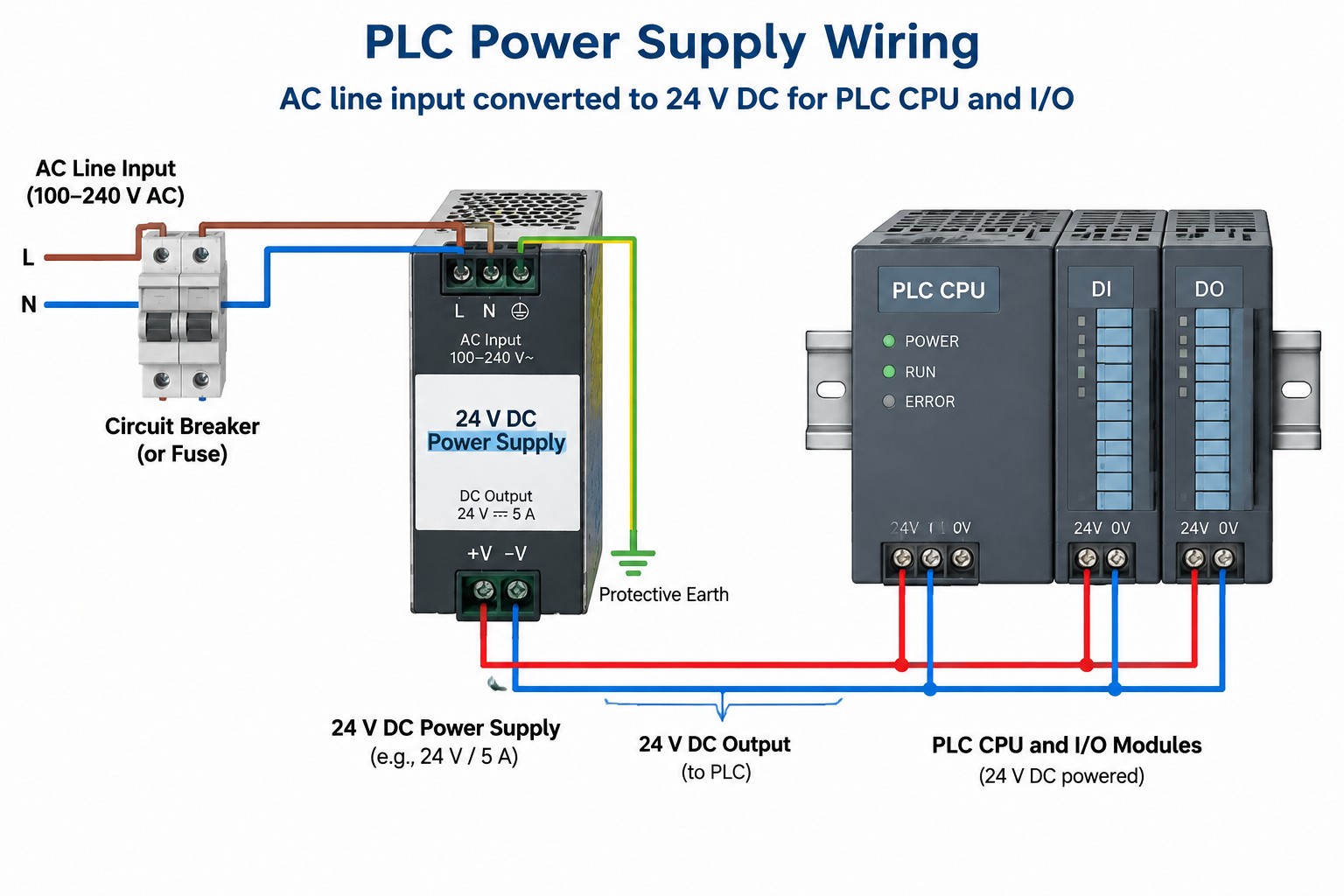
PLCs use both — but in different places. The PLC’s internal electronics and logic almost always run on DC, typically 24 V DC. The power supply module that feeds them usually takes AC line voltage (120/230 V AC) and converts it to that DC. Some CPUs and remote I/O stations accept DC supply directly. Knowing which side of the system is AC and which is DC saves real troubleshooting time — and prevents fried modules.
Key Takeaways
| Question | Short answer |
|---|---|
| Do PLCs run on AC or DC internally? | DC — the logic circuits run on 24 V DC in most industrial PLCs |
| Where does the DC come from? | A power supply module that rectifies AC line power, or an external 24 V DC feed |
| Can a PLC take DC input directly? | Yes — many CPUs and remote stations have DC supply variants |
| What kills PLC power supplies? | Heat, dust, and input surges — mostly preventable |
Do PLCs Use AC or DC? How PLC Power Actually Works
A rack-mounted PLC system divides the power job in two:
- Power supply module (PSU) — connects to the AC line (usually 120 or 230 V AC), converts and regulates it down to the system’s DC rail, most often 24 V DC
- Backplane bus — distributes that DC to the CPU and I/O modules through the rack
So when someone asks “do PLCs use AC or DC,” the honest answer is: the PLC consumes DC, but most standalone PSUs eat AC to make it. Small micro PLCs and remote I/O stations often skip the internal PSU and take 24 V DC straight from a panel supply. For background on how the rest of the controller works, see our PLC basics guide.
Which PLC Parts Run on AC and Which on DC?
| Component | Typical supply |
|---|---|
| Power supply module (e.g., Siemens PS307) | 120/230 V AC in, 24 V DC out |
| CPU (AC-supply version) | Fed 24 V DC from the rack PSU |
| CPU (DC-supply version) | 24 V DC directly from a panel supply |
| Digital input modules | Detect either AC (e.g., 120 V AC) or DC (24 V DC) field signals, per module type |
| Analog and communication modules | Powered from the backplane DC bus |
The field side can genuinely be AC: a digital input module rated for 120 V AC switches its channels by detecting AC field voltage. That does not mean the PLC logic runs on AC — the module converts the field signal to the rack’s internal DC logic level.
How Do You Choose or Replace a PLC Power Supply?
Five checks cover most PSU replacements:
- Input voltage range — match the site’s AC line (and check for a DC-input variant if your panel runs on a DC bus)
- Output rating — 5 A, 10 A, or more, sized to the rack’s total consumption including I/O surge current
- Backplane compatibility — the PSU must match the rack family (S7-300 PSUs do not fit S7-1500 racks, for example)
- Inrush and hold-up behavior — mismatched PSUs can cause the rack to brown-out during power dips
- Condition — for used units, ask for output ripple and load-test results before dispatch
Typical examples from our stock: a Siemens PS307 power supply module (24 V DC, 5 A) for S7-300 racks, and a Siemens CPU 313 with integrated 24 V DC supply for DC-fed configurations. The full range is in our PLC module catalog.
PLC dead and suspect the power supply? Measure the PSU output under load before swapping modules — and if you need a replacement, send us the part number on the PSU label. We will confirm the compatible unit: [email protected] or WhatsApp +86 15107352558.
What Usually Fails in a PLC Power Supply?
- Heat and dust — the two biggest PSU killers; clogged filters raise internal temperature and shorten capacitor life
- Input surges — lightning and switching transients take out front-end components; a surge device on the line side pays for itself
- Aged electrolytic capacitors — ripple rises slowly until the rack starts faulting intermittently
- Loose terminal screws — heat at the input terminals mimics PSU failure
Regular panel maintenance catches all four early — our PLC system maintenance tips include a practical checklist.
Frequently Asked Questions
Do PLCs use AC or DC power?
Internally, PLCs run on DC — almost always 24 V DC. The power supply module usually converts AC line power to that DC rail, while some CPUs and remote stations accept 24 V DC directly.
Can a PLC run on 24 V DC?
Yes. Many CPUs come in DC-supply versions, and remote I/O stations almost always run on 24 V DC from a panel power supply.
What happens if I wire AC into a DC-rated PLC input?
At best, nothing works; at worst, the input channel or backplane is destroyed. Always verify the module’s rated field voltage before wiring.
How do I know if my PLC power supply is failing?
Warning signs: intermittent CPU restarts, I/O modules dropping offline, the PSU’s DC OK indicator flickering, and output voltage sagging under load.
Is a used PLC power supply safe to buy?
Yes, if the seller load-tests output voltage and ripple and provides a warranty. PSUs are among the most reliable used buys when tested properly.
Get the Right PLC Power Supply
So, do PLCs use AC or DC? Both — and whichever your rack needs, the fastest fix is a tested, compatible unit. We stock 100,000+ automation parts from 20+ brands, every unit tested before dispatch, with 48-hour global shipping and no minimum order. Send the part number on your PSU or CPU: [email protected] or WhatsApp +86 15107352558.