

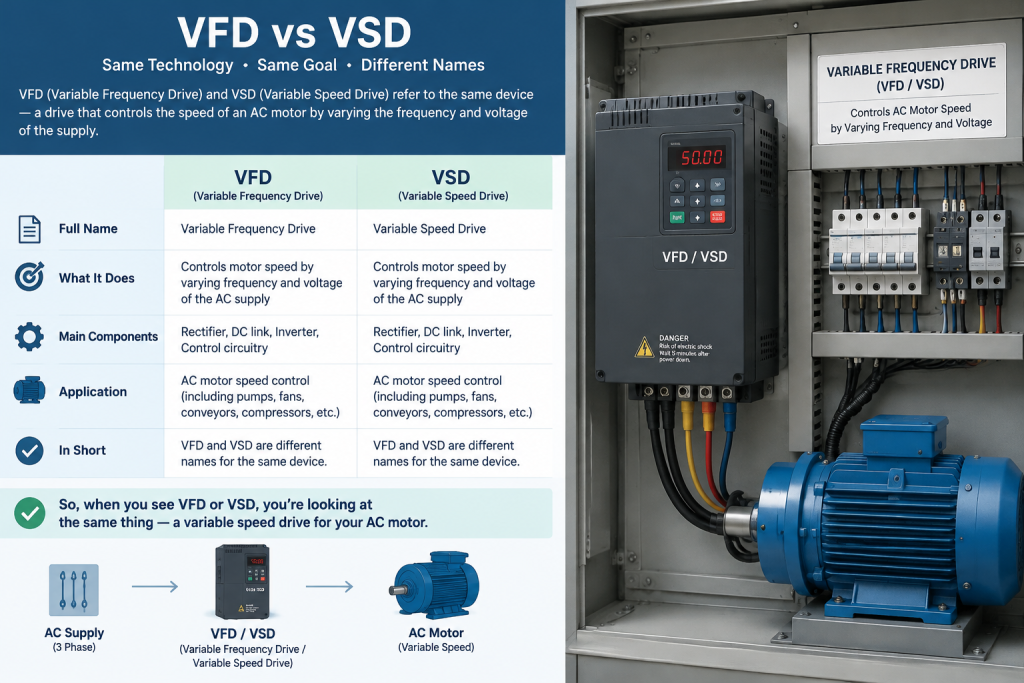
The VFD vs VSD question confuses a lot of engineers — and no wonder, because the two terms overlap. A VFD (variable frequency drive) is a type of VSD (variable speed drive). Every VFD is a VSD, but not every VSD is a VFD. The practical difference is what each one controls and how. This guide explains both, shows where each fits, and what to check before you buy a replacement unit.
Key Takeaways
| Question | Short answer |
|---|---|
| Is a VFD the same as a VSD? | No. A VFD is one type of VSD. |
| What does a VFD control? | AC motor speed by varying output frequency and voltage |
| What does a VSD control? | Motor speed generally — AC or DC, by several methods |
| Which do I need for an AC fan or pump? | A VFD in most cases |
What Is a VFD (Variable Frequency Drive)?
A variable frequency drive controls the speed of an AC motor by changing the frequency and voltage of the power it delivers. Inside a VFD, three stages do the work:
- Rectifier — converts incoming AC line power to DC
- DC bus — smooths the DC with capacitors
- Inverter — rebuilds AC output at the frequency and voltage the motor needs
Because motor speed follows frequency (in an induction motor, roughly), changing frequency changes speed directly while the VFD also holds the right volts-per-hertz ratio to keep torque stable. This makes VFDs the standard choice for AC fans, pumps, compressors, and conveyors.
What Is a VSD (Variable Speed Drive)?
A variable speed drive is the broader category: any drive that adjusts motor speed, on AC or DC motors, by any method. Besides variable frequency control, VSD methods include:
- Voltage control — common for DC motors and small AC motors
- Pulse-width modulation (PWM) — precise control for both AC and DC
- Eddy-current and hydraulic couplings — older mechanical variable-speed methods
So “VSD” is the family name; “VFD” is the member of that family used with AC motors.
What Is the Difference Between a VFD and a VSD?
| Point | VFD | VSD |
|---|---|---|
| Full name | Variable frequency drive | Variable speed drive |
| Motor type | AC motors | AC or DC motors |
| Control method | Varies output frequency and voltage | Frequency, voltage, PWM, or mechanical means |
| Efficiency | High — no extra losses in the power path | Depends on the method; electronic types are high |
| Typical use | Fans, pumps, compressors, conveyors | Anywhere motor speed must change, incl. DC systems |
In practice, when someone says “VSD” on a modern AC application, they usually mean a VFD. When the motor is DC — on older extruders, winding machines, or legacy equipment — the distinction matters.
VFD vs VSD: Which Drive Should You Choose for Your Application?
Five questions settle most VFD vs VSD decisions:
- Is the motor AC or DC? AC → a VFD. DC → a DC drive (a VSD, but not a VFD).
- Is the load a fan, pump, or compressor? VFDs give the biggest energy gains here because power drops with the cube of speed.
- How precise must speed control be? For tight regulation or positioning, look at servo drives instead — see our comparison of servo drives vs inverters.
- Does the drive must integrate with a PLC? Modern VFDs accept fieldbus and analog commands; our guide to VFD and PLC integration covers wiring and control modes.
- Is this a replacement or a new design? For replacements, matching the existing drive’s rating, control interface, and footprint matters more than the label on the box.
How Much Energy Can a VFD Actually Save?
On variable-torque loads (fans and pumps), motor power falls roughly with the cube of speed: a fan at 80% speed draws about half the power. That is why VFD retrofits on constant-speed throttling applications routinely pay back within one to three years, depending on running hours and electricity cost. On conveyors and mixers the savings are smaller but still real, mostly from soft starting and eliminating mechanical throttling.
Choosing between a VFD, a VSD, or a servo drive for a specific motor? Send us the motor nameplate data and what the machine does. Our engineers will point you to a compatible, tested unit: [email protected] or WhatsApp +86 15107352558.
What Should You Check Before Buying a Replacement Drive?
- Ratings — match voltage, current, and power rating to the motor, with a little headroom.
- Control interface — analog 0-10 V / 4-20 mA, Modbus, PROFIBUS, EtherNet/IP: your new drive must speak what the PLC speaks.
- Physical fit — panel cutout size and terminal layout on retrofit jobs.
- Condition and testing — ask for a supplier that powers up and load-tests each unit before dispatch, with a stated warranty.
We supply tested AC drives from Danfoss, Yaskawa, Lenze, Siemens, and other brands — browse our VFD catalog, inverter range, or a representative unit like the Danfoss FC-302 automation drive.
Frequently Asked Questions
Is every VFD a VSD?
Yes. A VFD is a type of VSD that controls AC motor speed through frequency. Other VSD types include DC drives and PWM controllers.
Can a VSD run a DC motor?
A VSD can — but only DC drive types. A standard VFD outputs variable-frequency AC and cannot run a DC motor directly.
Which is better for a water pump, VFD or VSD?
For an AC pump, a VFD is the right choice. It is the most efficient electronic speed-control method for AC motors and gives soft-start benefits as a bonus.
Do VFDs damage motors?
Not if matched correctly. Use a drive-rated motor (inverter-duty) for long cable runs or high switching frequencies, and keep carrier frequency settings within the motor manufacturer’s guidance.
Is it safe to buy a refurbished VFD or VSD?
Yes, with a supplier that tests each unit under load and provides a warranty. Verify voltage, current, and control-interface compatibility with your motor and PLC before ordering.
Get a Tested Drive Without the Wait
The right VFD vs VSD choice only pays off if the unit arrives working. We stock 100,000+ automation parts from 20+ brands — drives included — every unit tested before dispatch, with 48-hour global shipping and no minimum order. Send your part number or motor data: [email protected] or WhatsApp +86 15107352558.