

What Is a Unitary PLC?
A unitary PLC, also called a fixed PLC, combines the CPU, power supply, digital inputs, and digital outputs in one non-separable housing. It is a simple, cost-effective option for small machines and standalone automation applications where the number of I/O points is unlikely to change.
What Is a Fixed PLC?
A fixed PLC is another name for a unitary PLC. The controller has a fixed configuration, so users cannot add or replace individual I/O modules. Fixed PLCs are easy to install and maintain, but they provide limited flexibility for future system expansion.
What Is a Rack-Mounted PLC?
A rack-mounted PLC uses a chassis, rack, or backplane to hold the CPU, power supply, communication modules, and multiple I/O modules. The PLC chassis comes in different sizes according to the number of modules required, making rack-mounted systems suitable for medium and large automation applications.
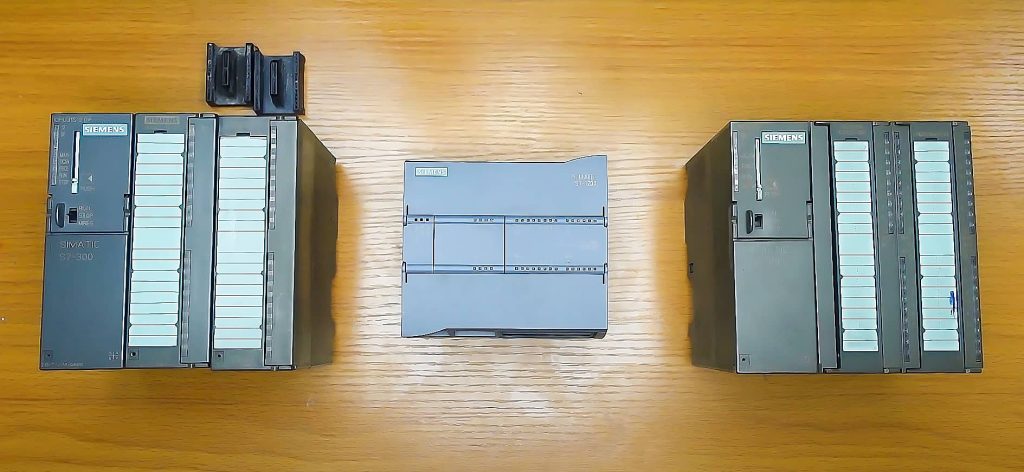
Modular PLC vs Compact PLC vs Unitary PLC
| PLC Type | Structure | Expansion | Best For |
|---|---|---|---|
| Modular PLC | Separate CPU, power supply, and I/O modules | Highly expandable | Medium to large automation systems |
| Compact PLC | CPU and I/O integrated in one housing | Limited expansion through add-on modules | Small and medium machines |
| Unitary / Fixed PLC | CPU, power supply, and I/O built into one unit | Usually not expandable | Simple standalone machines |
| Rack-Mounted PLC | Modules installed in a rack or chassis | Highly scalable | Large process automation and production lines |
Common PLC Modules and Their Functions
A modular PLC system can be configured with different types of PLC modules. These modules connect to the CPU and extend the controller’s input, output, communication, and special-function capability.
| PLC Module Type | Function | Typical Applications |
|---|---|---|
| Digital Input Module | Reads on/off signals from field devices | Push buttons, limit switches, sensors, relays |
| Digital Output Module | Controls on/off output devices | Contactors, valves, indicator lamps, alarms |
| Analog Input Module | Reads continuous signals such as 4–20 mA or 0–10 V | Temperature, pressure, flow, and level sensors |
| Analog Output Module | Sends continuous control signals | VFDs, control valves, actuators |
| Communication Module | Adds industrial network connectivity | EtherCAT, PROFINET, Modbus, Ethernet/IP |
| Specialty Module | Handles dedicated automation functions | High-speed counting, temperature control, motion control |
PLC Applications by Machine Size
Compact PLCs and unitary PLCs are commonly used for small machine control, packaging equipment, pumps, conveyors, and simple automated cells. They save control-panel space and reduce wiring complexity.
Modular PLCs and rack-mounted PLCs are better suited to large process automation, production lines, water treatment plants, power distribution systems, and applications that require many I/O points, advanced communication, redundancy, or future expansion.
PLC FAQs
What are the three main types of PLCs?
The three main types of PLCs are modular PLCs, compact PLCs, and integrated PLCs. A modular PLC uses separate CPU and I/O modules, a compact PLC combines the CPU and I/O in one housing, and an integrated PLC has a fixed design for simple applications.
What is the difference between modular and compact PLCs?
A modular PLC separates the CPU from input and output modules, allowing users to expand or reconfigure the system. A compact PLC integrates the CPU and I/O modules in a single unit, making it easier to install but less flexible for expansion.
Which PLC type is best for small machines?
A compact PLC is usually best for small machines because it combines the CPU, digital I/O, and often analog I/O in one unit. It saves space, reduces wiring, and is suitable for applications that do not require major future expansion.
Can a compact PLC be expanded?
Yes, many compact PLCs can be expanded, but usually only to a limited extent. They may support a small number of expansion modules for additional digital or analog I/O. Modular PLCs offer much greater expansion flexibility.
What are examples of PLC modules?
Examples of PLC modules include digital input modules, digital output modules, analog input modules, analog output modules, communication modules, and specialty modules such as high-speed counter, temperature input, or motion control modules.
What is a unitary PLC?
A unitary PLC, or fixed PLC, combines the CPU, power supply, and input/output circuits in one fixed housing. It is designed for small machines and simple automation tasks where the I/O configuration is unlikely to change.
What is a rack-mounted PLC?
A rack-mounted PLC is a modular PLC installed in a rack or chassis. The chassis holds the CPU, power supply, communication modules, and I/O modules, allowing the system to scale according to application requirements.
What are the main parts of a modular PLC?
A modular PLC typically consists of a CPU module, power supply, digital input and output modules, analog input and output modules, communication modules, and a rack or backplane that connects the modules.
What are examples of PLCs?
Examples of PLC applications include conveyor systems, packaging machines, injection molding machines, water treatment plants, building automation systems, food processing lines, and industrial robotic cells.
What types of PLCs are used for small machine control versus large process automation?
Compact and unitary PLCs are usually used for small machine control because they are compact, affordable, and easy to install. Modular and rack-mounted PLCs are preferred for large process automation because they support more I/O points, communication protocols, redundancy, and expansion.
What are the main features of a PLC?
The main features of a PLC include programmable logic, rugged industrial construction, digital and analog I/O, real-time control, communication interfaces, diagnostics, and expandability. Modular PLCs offer the highest expandability, while compact and unitary PLCs prioritize simplicity and space savings.
What is the difference between a PLC and a PAC?
A PLC is mainly used for deterministic machine control, while a PAC, or programmable automation controller, combines PLC control with advanced data processing, IT integration, and multi-domain automation functions.