

Inverter voltage fluctuation usually means the output voltage is unstable, connected lights flicker, equipment resets, or the inverter keeps switching on and off. Common causes include overload, loose wiring, weak input power, battery or DC-link problems, overheating, and incorrect inverter or VFD settings.
This guide explains why an inverter fluctuates, whether voltage fluctuation can damage an inverter, and how to troubleshoot both home backup inverters and industrial VFDs. If your issue involves a VFD, servo drive, CNC machine, PLC, HMI, or motor control system, you can also contact OUKE Automation with your part number and fault code.
Quick Answer: Why Is My Inverter Fluctuating?
If your inverter voltage keeps fluctuating, start with these checks:
- Reduce the load. An overloaded inverter often causes voltage drops, flickering lights, alarms, or automatic shutdown.
- Check all wiring terminals. Loose, corroded, or undersized cables create voltage drops and unstable output.
- Check the input power supply. Low grid voltage, frequent power cuts, or unstable generator output can affect inverter performance.
- Check battery voltage and connections for home backup inverters.
- Check ventilation and temperature. Overheating can trigger protection and cause repeated on/off cycling.
- Check the fault code or display alarm. Modern inverters and VFDs usually identify undervoltage, overvoltage, overload, overheating, or DC-link faults.
- Measure voltage under load. Voltage may look normal with no load but drop sharply when motors, pumps, compressors, or air conditioners start.
If the problem occurs on a CNC machine, motor control panel, pump, fan, conveyor, or other industrial equipment, the issue may be related to the VFD input supply, DC bus voltage, motor load, grounding, or drive parameters. See the VFD troubleshooting checklist below.
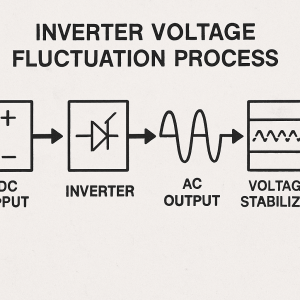
Can an Inverter Cause Voltage Fluctuation?
Yes, an inverter can cause voltage fluctuation, but it is not always the root cause.
An inverter converts DC power into AC power. If its control circuit, output stage, battery or DC link, or protection system is unstable, the output voltage may rise, fall, or become inconsistent. This can cause lights to flicker, sensitive electronics to reset, or motors to run unevenly.
However, in many cases the inverter is reacting to an external problem, such as:
- Unstable grid voltage
- Poor generator output
- Overloaded circuits
- Loose or damaged wiring
- Weak or aging batteries
- Sudden motor starting current
- Poor grounding
- Faulty voltage measurement or control board
The correct approach is to determine whether the fluctuation comes from the input supply, the inverter itself, or the connected load.
Does Voltage Fluctuation Affect an Inverter?
Yes. Voltage fluctuation can affect an inverter and may shorten its service life.
Low input voltage can force the inverter to work harder, increase current draw, trigger undervoltage protection, or cause repeated restarts. High voltage can stress capacitors, power modules, and control circuits. Rapid voltage changes may also cause nuisance trips, DC-link voltage instability, and premature component failure.
Common effects include:
- Inverter switching on and off automatically
- Output voltage instability
- Lights flickering on inverter power
- Motor speed variation
- VFD undervoltage or overvoltage trips
- Overheating
- Reduced battery life
- Damage to capacitors, IGBTs, or control boards
- Unexpected shutdown of sensitive equipment
For industrial VFDs, voltage fluctuation is especially important because drives rely on a stable DC bus voltage. Input disturbances can appear as DC bus ripple, undervoltage faults, overvoltage faults, or torque instability.

Inverter Keeps Switching On and Off: Common Causes
If your inverter keeps switching on and off automatically, it is usually entering protection mode. Do not keep resetting it without checking the cause.
| Symptom | Likely cause | What to check first |
|---|---|---|
| Inverter turns off when a large appliance starts | Overload or high inrush current | Reduce load; check appliance rated power and starting current |
| Inverter restarts repeatedly | Low input voltage, weak battery, overheating, or loose connection | Check input voltage, battery voltage, terminals, and cooling |
| Lights flicker but inverter stays on | Loose output wiring, unstable DC source, or overloaded circuit | Check output terminals, load current, and battery or DC-link voltage |
| Inverter shuts down after running for a while | Overheating or gradual overload | Check fan, vents, ambient temperature, and load percentage |
| Inverter trips when motor starts | Insufficient capacity or excessive starting current | Use soft start, reduce load, or select a larger inverter or VFD |
| VFD trips with undervoltage fault | Input voltage sag, phase loss, or DC bus undervoltage | Measure all input phases and DC bus voltage |
| VFD trips with overvoltage fault | Regenerative load, deceleration too fast, or high input voltage | Check braking resistor, deceleration time, and input voltage |
Lights Flickering on Inverter: Causes and Fixes
Flickering lights are one of the most common signs of inverter fluctuation.
Possible causes include:
- Loose neutral, live, or earth connection
- Overloaded inverter output
- Weak or aging batteries
- Poor battery terminal contact
- Low input voltage from the grid or generator
- Faulty inverter output stage
- Voltage drop across long or undersized cables
- Large loads cycling on and off, such as pumps, compressors, or air conditioners
How to fix flickering lights
- Turn off non-essential loads.
- Tighten all input, output, battery, and earth terminals.
- Measure battery voltage with and without load.
- Check whether flickering stops when the heavy load is removed.
- Inspect cables for overheating, corrosion, or damage.
- If flickering only happens when a motor starts, the inverter may be undersized for the starting current.
- If flickering continues with no load, test the inverter output with a multimeter or clamp meter and arrange professional inspection.

Home Inverter vs Industrial VFD Fluctuation
“Inverter” can mean two very different devices. The troubleshooting steps are not always the same.
| Item | Home backup inverter | Industrial VFD |
|---|---|---|
| Main function | Converts battery DC power to AC power | Controls motor speed by converting AC to DC and back to variable-frequency AC |
| Common fluctuation signs | Lights flicker, appliances reset, inverter switches on/off | Motor speed changes, drive trips, DC bus fault, torque instability |
| Common causes | Battery issues, overload, loose wiring, weak grid or generator supply | Input voltage sag, phase imbalance, DC bus ripple, overload, wrong V/F or vector settings |
| Key measurements | Battery voltage, output voltage, load current | Input phase voltages, DC bus voltage, output voltage and frequency, motor current |
| Typical solutions | Reduce load, replace batteries, tighten terminals, use stabilizer | Check power quality, add line reactor, adjust ramp times, inspect braking resistor, verify drive parameters |
If you are troubleshooting a VFD, servo drive, CNC machine, PLC panel, pump, fan, conveyor, or motor control system, focus on the industrial VFD checklist below. OUKE supplies replacement parts and support for major automation brands, including Siemens, Fanuc, ABB, Yaskawa, Mitsubishi, and Allen-Bradley.
VFD Voltage Fluctuation Troubleshooting
For an industrial VFD, voltage fluctuation often appears as an alarm rather than visible light flickering.
1. Check input power quality
Measure voltage at the VFD input terminals during the fault.
Check for:
- Low voltage
- High voltage
- Voltage imbalance between phases
- Phase loss
- Voltage sags when large motors start
- Generator instability
- Loose input terminals
- Poor contactors or circuit breakers
A VFD may trip on undervoltage if one phase is weak or missing, even when the other phases appear normal.
2. Check DC bus voltage
The DC bus is the intermediate DC circuit inside the VFD. Input disturbances and load changes can cause DC bus voltage ripple or abnormal voltage.
Check:
- DC bus voltage against the VFD manual range
- DC bus ripple
- Capacitor health
- Braking resistor and braking unit condition
- Whether voltage rises during deceleration
High DC bus voltage during deceleration often points to regenerative energy that cannot be dissipated quickly enough.
3. Check motor load and acceleration settings
Sudden load changes can make the VFD output unstable.
Check:
- Motor current during startup and operation
- Mechanical jamming or excessive friction
- Belt tension, coupling alignment, and bearing condition
- Acceleration and deceleration times
- V/F pattern or vector control settings
- Torque boost settings
- Carrier frequency settings
If the motor draws excessive current during acceleration, increase acceleration time or reduce the load.
4. Check grounding and EMC
Poor grounding can cause measurement errors, nuisance trips, and unstable control signals.
Check:
- VFD earth terminal connection
- Motor frame grounding
- Shielded motor cable and proper shield termination
- Separation of power and control cables
- Control wiring near high-voltage cables
- EMC filters and line reactors where required
5. Check VFD fault history
Do not rely only on the current alarm. Check the fault history to see whether the issue is undervoltage, overvoltage, overcurrent, overload, overtemperature, DC bus fault, phase loss, output short circuit, encoder fault, or communication fault.
The fault pattern helps distinguish between power-supply problems, mechanical load problems, and internal drive faults. If you need a replacement drive, send the exact part number through the OUKE contact page.

How to Diagnose Inverter Voltage Fluctuation
Use this sequence to isolate the cause.
Step 1: Identify when it happens
Ask:
- Does it happen at no load or only under load?
- Does it happen when a motor, pump, compressor, or air conditioner starts?
- Does it happen during grid power, battery mode, or generator mode?
- Does it happen after a fixed running time?
- Does the inverter show a fault code?
Step 2: Measure input voltage
Measure the input voltage at the inverter terminals.
- If input voltage is unstable, the issue may be the grid, generator, wiring, or upstream connection.
- If input voltage is stable but output fluctuates, inspect the inverter, battery or DC link, output terminals, and load.
Step 3: Measure output voltage under load
Measure output voltage with:
- No load
- Normal load
- Peak load
- Motor starting condition
A significant voltage drop under load often indicates overload, weak DC source, loose terminals, or insufficient cable size.
Step 4: Check current
Use a clamp meter to check current on the input and output sides.
Compare the measured current with:
- Inverter rated current
- Motor rated current
- Appliance rated current
- Cable current capacity
If current exceeds the rated value, reduce the load or upgrade the inverter or VFD.
Step 5: Inspect wiring and connections
Check:
- Input terminals
- Output terminals
- Battery terminals
- Earth terminals
- Cable size
- Connector tightness
- Burn marks or discoloration
- Corrosion
- Damaged insulation
Loose connections are one of the most common and most overlooked causes of fluctuation.
Solutions for Inverter Voltage Fluctuation
Reduce or redistribute the load
Do not run high-power appliances or motors beyond the inverter rating. Separate heavy loads onto different circuits or use a larger inverter or VFD.
Repair loose or damaged wiring
Tighten terminals, replace corroded connectors, and use correctly sized cables. Poor connections create resistance, heat, and voltage drop.
Improve input power quality
If the grid or generator supply is unstable, consider:
- Voltage stabilizer
- AVR
- Online UPS for sensitive loads
- Line reactor for VFD
- Isolation transformer
- Better generator sizing and voltage regulation
Replace weak batteries
For home backup inverters, aging batteries can cause voltage sag and flickering. Test battery voltage under load and replace batteries that cannot hold voltage.
Improve cooling
Clean vents and fans, ensure free airflow, and keep the inverter away from heat sources. Overheating can cause derating, alarms, and repeated shutdowns.
Adjust VFD parameters
For industrial drives, review:
- Acceleration and deceleration time
- V/F curve
- Torque boost
- Carrier frequency
- DC bus voltage protection limits
- Braking resistor or braking unit settings
- Motor nameplate data
- Control mode
Incorrect parameters can make a healthy VFD appear unstable.
Use a line reactor or EMC filter
For VFDs exposed to poor power quality, long motor cables, harmonics, or frequent voltage disturbance, a line reactor or EMC filter can reduce stress on the drive and improve stability.
When Should You Replace the Inverter or VFD?
Consider replacement if:
- The inverter fluctuates even with no load and no wiring fault
- The unit repeatedly trips despite correct load and input voltage
- There are burn marks, capacitor swelling, unusual noise, or a burning smell
- The fault code indicates internal power-stage or control-board failure
- The VFD has repeated DC bus, IGBT, or output-stage faults
- The equipment is old, discontinued, or repair costs exceed replacement cost
For industrial equipment, replacing an obsolete or unstable VFD with a correctly sized modern drive is often more reliable than repeated repairs. OUKE can help source compatible automation parts across major brands; see the full product range.
FAQ
Can an inverter cause voltage fluctuation?
Yes. A faulty inverter, overloaded inverter, weak battery or DC link, loose wiring, or unstable input supply can cause output voltage fluctuation.
Does voltage fluctuation damage an inverter?
Yes. Repeated low or high voltage can stress capacitors, power modules, batteries, and control circuits. It may also cause nuisance trips and premature failure.
Why does my inverter keep switching on and off?
The most common reasons are overload, overheating, low input voltage, weak batteries, loose wiring, or a protection fault. Check the fault code before resetting the unit.
Why do lights flicker when using an inverter?
Lights may flicker because of overload, loose terminals, voltage drop, weak batteries, or unstable input power. If flickering occurs only when a heavy appliance starts, the inverter may be undersized.
Can an inverter AC handle voltage fluctuations?
Some inverter air conditioners tolerate a limited voltage range, but severe or frequent fluctuation can still cause errors, poor cooling performance, or damage. Use a stabilizer if your area has frequent voltage variation.
Does an inverter stabilize voltage?
A normal home backup inverter is not primarily a voltage stabilizer. Some models regulate output within a limited range, but severe input fluctuation, overload, or battery problems can still cause unstable output. For sensitive equipment, use a stabilizer, online UPS, or properly specified power-conditioning solution.
Why is my VFD voltage fluctuating?
For a VFD, check input voltage balance, DC bus voltage, motor load, acceleration and deceleration settings, braking resistor, grounding, and fault history. Voltage fluctuation may come from the supply, load, wiring, or drive settings.
Need a Replacement VFD or Automation Part?
If your inverter fluctuation problem involves a VFD, servo drive, CNC machine, PLC, HMI, motor, or industrial automation component, OUKE Automation can help you identify compatible replacement parts.
Send us:
- Equipment brand and model
- VFD or drive part number
- Fault code or alarm message
- Motor power and voltage
- Photo of the nameplate or control panel
OUKE supports industrial automation components for brands includingSiemens,Fanuc,ABB,Yaskawa,Mitsubishi,Schneider,Delta, andAllen-Bradley.Get a Quote for VFDs and Automation Parts