

Understanding FANUC Motor Model Numbers
When shopping for replacement or upgrade motors, understanding FANUC motor model numbers is crucial. FANUC, a leader in industrial automation, assigns specific codes to their servo motors to indicate their features, versions, and compatibility. Two common models in the A06B series are the A06B-0075-B003 and the A06B-0075-B103. These numbers aren’t just random; they follow a structured naming convention that helps identify the motor’s characteristics at a glance.
FANUC Naming Convention Breakdown
The model numbers typically follow a format like A06B-XXXX-XXXXX. Here’s what each part usually represents:
- A06B: The series or product family.
- XXXX: The motor type or series within the family.
- XXXXX: Specific model or revision, often including the B code that indicates version or design changes.
What the A06B Series Code Means
The A06B series covers a wide range of servo motors designed for CNC machines, robotics, and automation systems. These motors are known for high precision, durability, and compatibility with FANUC controllers. The series number signals the motor’s generation and intended application, with newer series often offering improved performance or features.
How B003 and B103 Fit Into the Model Structure
The B003 and B103 at the end of the model number denote different versions or revisions of the same motor type within the A06B series. These B codes highlight design updates, component changes, or performance enhancements made by FANUC over time.
Why Model Variations Matter for Compatibility and Performance
Choosing the correct model variant—whether B003 or B103—is important because:
- Compatibility: Different revisions may have varying connectors, feedback systems, or mounting options.
- Performance: Updated models often come with improved features like better efficiency or longer service life.
- Replacement Accuracy: Using the wrong revision could lead to issues with communication, operation, or fit.
In short, understanding what these model distinctions mean ensures you get the right motor for your machine’s needs and avoid costly mistakes.
B Code Meaning in FANUC Motors
The B code in FANUC motors, like A06B-0075-B003 or A06B-0075-B103, indicates specific revisions, design enhancements, or feature updates within a series. It helps identify subtle differences that can impact compatibility, performance, or lifespan. Essentially, the B code acts as a version tag, telling technicians and buyers if the motor includes updates from previous models. For instance, a change from B003 to B103 might mean improved internal components or adjustments to meet newer standards.
What the B Code Means in FANUC Motors
The B code is not arbitrary; it signals certain modifications or revisions made by FANUC over time. These updates could involve:
- Internal hardware changes
- Design improvements
- Enhanced feedback systems
- Better thermal management
Such revisions aim to boost motor durability and efficiency, ensuring users get longer-lasting, more reliable performance. Knowing what these B codes signify helps in making informed decisions during replacements or upgrades.
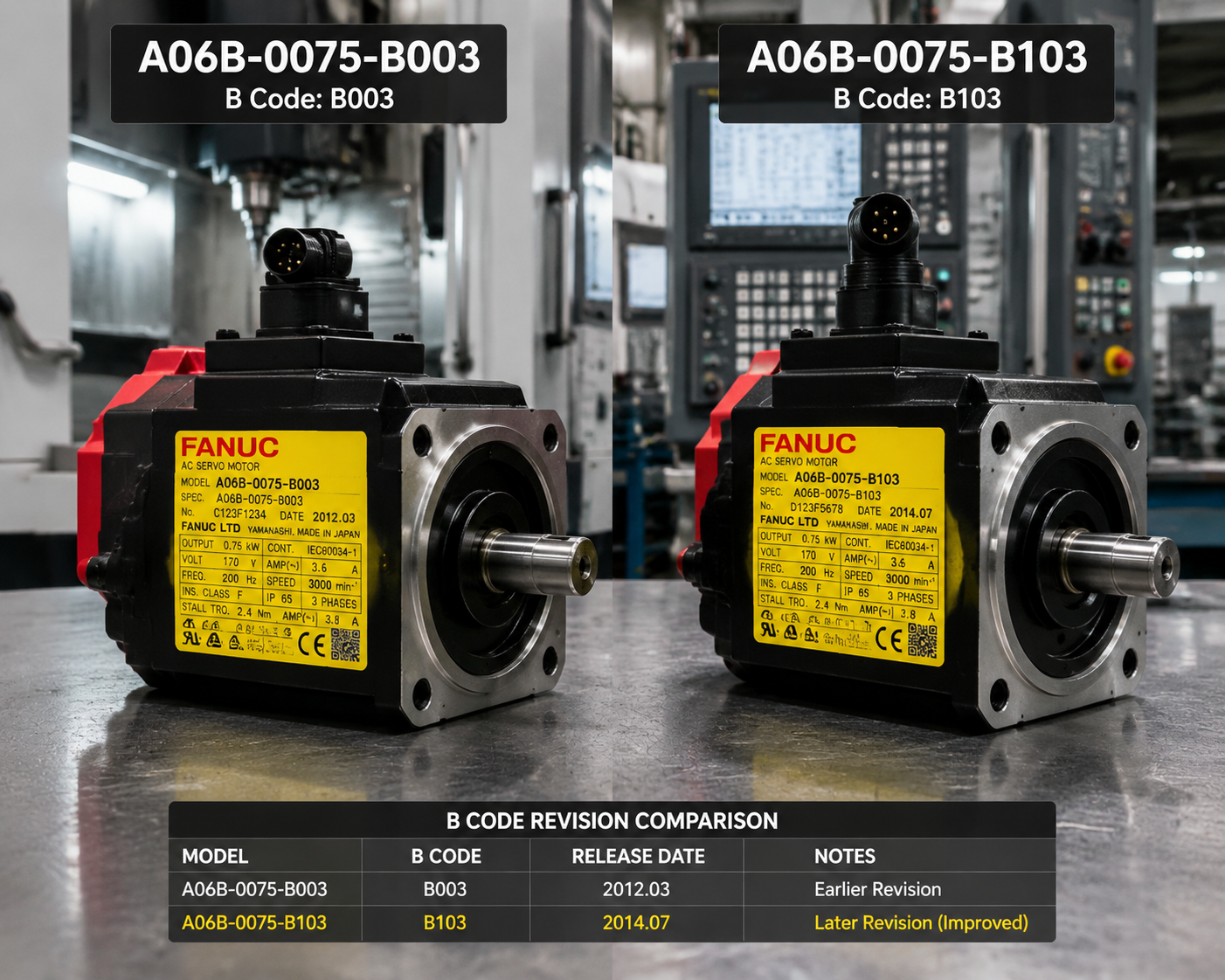
B003 vs B103: How to Interpret the Difference
When comparing B003 versus B103 in FANUC A06B-0075 motors, the key is understanding these codes reflect different generations or design tweaks. The B103 often indicates a more recent revision, generally offering:
- Better reliability
- Slight improvements in torque or speed
- Updated internal electronics or feedback mechanisms
However, it’s important to verify if these differences are critical to your application. Sometimes, the updates are minor, but for high-precision or heavy-duty uses, choosing the latest B code (B103) can assure longer-term performance.
Why the B Code Matters for Replacement Decisions
The B code is crucial when sourcing replacement motors because it ensures compatibility and consistent performance. Using a motor with the wrong B code might:
- Lead to fitment issues
- Cause communication problems with your controller or drive system
- Result in mismatched electrical connections or feedback signals
Choosing the correct B code means fewer troubleshooting headaches and a smoother integration into your existing automation setup. Always confirm with the official specifications or consult a FANUC specialist before replacing, especially if the application relies heavily on precision or high-speed operation.
Technical Specs Comparison: FANUC A06B-0075-B003 Motor vs B103
Here’s a quick side-by-side of the key specs for the A06B-0075 series, focusing on B003 and B103 models. Both share many core features, but there are important differences to know before making a replacement.
Shared Specifications in the A06B-0075 Series
| Feature | Description |
|---|---|
| Power Supply Voltage | Typically 200-230V AC |
| Feedback Type | Optical encoders or resolvers (depends on the model) |
| Mounting Style | Standard flange mount |
| Shaft Length & Diameter | Common sizes (check specific datasheets) |
| Usage | Mainly for CNC, robotics, and automation systems |
B003 vs B103: Side-by-Side Comparison
| Specification | FANUC A06B-0075-B003 | FANUC A06B-0075-B103 |
|---|---|---|
| Voltage | 200-230V | 200-230V |
| Max Continuous Current | ~4.5A | Slightly higher, around 5A |
| Max Torque | ~2.0 Nm | Slightly higher torque output |
| Speed Range | 3000-6000 RPM | Similar, but may vary slightly |
| Feedback System | Optical encoder, 2500 CPR or similar | Same feedback type, often upgraded |
| Shaft Design | Standardshaft with keyway | Similar, but some models include a different shaft style for specific applications |
| Mounting & Flange | Standard FANUC flange | Same mounting pattern but verify dimensions |
What to Verify Before Buying
- Voltage Compatibility: Confirm voltage ratings match your machine.
- Feedback System: Ensure encoder type and CPR count align with your controller.
- Mechanical Fit: Check shaft diameter, length, and mounting flange specs.
- Performance Needs: Think about required torque and speed for your application.
Pay attention to these details to avoid compatibility issues, especially if you’re replacing a motor in a critical CNC or robotics setup.
Compatibility Check for FANUC A06B-0075 Motor: Ensuring Proper Fit and Function
When replacing or upgrading a FANUC A06B-0075-B003 or B103 motor, compatibility is key. First, verify that your controller and drive systems support the specific B code version. Even small differences can affect communication and control protocols, so double-checking compatibility with your CNC or automation system is essential. You can find more about FANUC control and automation integration to ensure smooth operation.
Next, look at the connector and feedback system. The B003 and B103 might use different feedback mechanisms—like resolver vs. encoder—or different pin configurations. Matching these elements prevents wiring issues or functional errors down the line. Always compare the motor’s feedback type and connector interface with your existing setup.
Mechanical fit and mounting are also critical. Ensure the motor’s dimensions, shaft size, and mounting holes align with your machine’s specifications. A mismatch here could mean costly modifications or reduced performance. For detailed specs, check the official sample parts here.
Finally, if the part number doesn’t match, it’s a red flag. Using an incompatible B003 in place of a B103—or vice versa—may cause issues ranging from poor performance to outright failure. Always verify the original part number before purchasing, and consult with a FANUC technician if unsure. Proper compatibility checks can save time, money, and prevent downtime.
Performance Differences: FANUC A06B-0075-B003 vs B103
When comparing the FANUC A06B-0075-B003 and B103, a few key performance factors stand out.
Power Output & Efficiency
The B103 typically offers higher power and torque compared to B003, making it better suited for demanding applications like heavy CNC machining or automation systems. Its design usually results in better efficiency which helps reduce energy costs in continuous operation.
Durability & Reliability
Both motors are built tough, but the B103 often features design upgrades that improve durability over time. This means less downtime and more reliable performance in rough industrial environments. If you’re operating heavy-duty or long-term setups, B103 might have a slight edge.
Maintenance & Service Life
In general, B103 motors tend to have a longer service life due to updated components or improved design. However, the actual lifespan depends on proper maintenance. Regular checks of feedback systems and cooling are key to keeping both models running smoothly.
When One Version May Perform Better
- For high-demand, heavy-duty tasks: B103 usually performs better because of its increased power and durability.
- For lighter or standard applications: B003 could be enough, offering a lower upfront cost but still reliable performance.
In sum, if you need maximum power and long-term reliability, the B103 may be worth the extra investment. For general use or budget projects, the B003 often does the job. It’s always a good idea to review your machine’s specific needs before choosing.
For more detailed specs and compatibility info, check out this FANUC servo motor comparison.
Applications of FANUC A06B-0075-B003 and B103 Motors
FANUC servo motors like the A06B-0075-B003 and B103 are key components in a range of industrial automation setups. These motors are commonly used in CNC machines, robotics, and other automation systems where precision, reliability, and speed matter.
CNC Machine Use Cases
In CNC machining centers, these motors drive axes for cutting, drilling, or milling. The B003 is often used in older or more straightforward setups, while the B103 might be found in newer, higher-performance machines that demand more torque or faster response times. The choice really depends on the specifics of the CNC application’s needs.
Robotics and Automation Systems
In robotics, these FANUC motors provide smooth operation and precise control for robotic arms or pick-and-place stations. The B103 version, with its potentially improved features, can fit applications needing faster cycle times or more consistent performance.
Industrial Replacement Scenarios
When replacing a motor in an industrial setting, matching the right model is critical. Whether upgrading or replacing a faulty unit, understanding how the B003 and B103 differ can ensure the new motor continues to meet your application’s demands. More info on selecting the right servo motor for automation can help avoid costly downtime.
How Application Needs Affect Motor Choice
The type of task, speed requirements, load, and environment all influence whether you opt for a B003 or B103. For lighter, slower tasks, the B003 might do just fine, but for high-speed, high-torque applications, the B103 could be the better fit. Ensuring your motor matches your machine’s needs helps improve longevity and performance.
Replacement Guide: Can B003 Replace B103 and Vice Versa?
When it comes to replacing FANUC motors like the A06B-0075-B003 and B103, it’s important to understand whether they are interchangeable. These model variations often have subtle differences that can affect compatibility and performance.
Can B003 replace B103?
In many cases, B003 can serve as a replacement for B103, especially if your application doesn’t require the specific features introduced in the newer model. However, you’ll need to verify if the sample specifications—such as voltage, torque, and feedback type—match. Simply swapping parts without checking these details may lead to issues with performance or warranty.
Can B103 replace B003?
Conversely, B103 might be considered a direct upgrade in some scenarios, but it’s not always a straightforward swap. The B103 usually incorporates revision updates or design improvements, so ensure that your drive system and mechanical fit support the newer version before installing.
Steps to confirm interchangeability:
- Check technical specs: Compare voltage, current, torque, and feedback systems (FANUC specs) to ensure compatibility.
- Verify mechanical fit: Confirm mounting holes, shaft diameter, and connector types.
- Review the B code details: Different B codes often indicate updated features or revisions that could impact use.
Common replacement mistakes to avoid:
- Overlooking subtle differences in feedback systems (e.g., resolver vs. encoder).
- Installing a motor with mismatched voltage or current ratings, leading to system failure.
- Ignoring updates in the B code that might require firmware or drive modifications.
Properly matching motor models is crucial for keeping your automation systems running efficiently. When unsure, consulting with a FANUC specialist or reading the official specifications can help avoid costly mistakes.
Troubleshooting Tips for FANUC A06B-0075 Series Motors
When dealing with FANUC A06B-0075 series motors, troubleshooting can save you time and prevent unnecessary parts replacement. Here are some common motor issues and what to look for, especially concerning differences in the B codes like B003 and B103.
Common Motor Issues in the A06B-0075 Series
- Motor not starting or intermittent operation
- Unusual noises or vibrations
- Overheating during operation
- Error codes on the controller or drive system
- Reduced performance or torque loss
Symptoms of Mismatch or Failure
- If the motor suddenly stops or runs unpredictably, it could be a mechanical or electrical mismatch.
- Error messages related to feedback system or power issues often point to compatibility problems between different B codes, such as B003 vs B103.
- Frequent overheating might signal the wrong motor for your application or one with different specs.
How the B Code Affects Diagnostics
The B code in FANUC motors indicates specific revisions, design features, or updates. For example, a B003 might have different internal components compared to a B103, which impacts diagnostics.
- If you’re troubleshooting using the controller diagnostics, understanding whether you have a B003 or B103 can help pinpoint the root cause.
- When replacing a motor, matching the B code ensures compatibility and proper diagnostics.
Basic Checks Before Ordering a Replacement
- Verify the motor’s part number and B code for exact match.
- Inspect the wiring and connectors for any corrosion or damage.
- Check feedback devices (like encoders) for proper operation.
- Ensure mechanical mounting is aligned correctly to prevent undue stress.
- Review your drive and controller settings to make sure they support the motor model you’re using.
Doing these simple checks can save frustration and help determine if the problem is with the motor itself or something external. For more detailed specs, you might want to explore our FANUC motor options, which provide options tailored for the A06B series.
Pricing and Availability of FANUC B Series Motors
When it comes to fanuc A06B-0075-B003 versus B103 motors, pricing can vary quite a bit. Generally, the older B003 models tend to be less expensive because they are more common and have been in the market longer. However, sometimes newer versions like B103 can cost more upfront due to updated features or improved performance, especially if they’ve been redesigned for better durability or efficiency.
Availability can also be a challenge, especially if you need an exact match for your machine. Older B003 motors may be harder to find as supplies dwindle, while B103 models might be more readily available from suppliers or on the secondary market. If you’re uncertain about matching exact specifications, sourcing support from trusted suppliers like OUKE CNC can make a big difference—they often help you locate specific versions or compatible alternatives. For more details on compatible motors, you might want to check out their inventory of servo motors here.
How to Choose the Right FANUC Motor
Picking the right motor, like the FANUC A06B-0075-B003 or B103, is about matching it to your machine’s needs. Before you buy, always check the technical specs to make sure it fits your application. Look at voltage, torque, speed, and feedback type—these are crucial for proper operation.
Tip: For CNC machines or robotics, choose a motor with the right power output and durability. Sometimes, the differences in B codes, like B003 vs B103, affect performance and compatibility, so compare these details carefully.
| Step | Action | Why it Matters |
|---|---|---|
| Match to machine | Confirm that the motor’s specs match your equipment | Prevents issues later |
| Check specs | Voltage, current, torque, feedback system | Ensures proper fit |
| Balance budget & stock | Find a motor that balances cost and availability | Saves time & money |
| Consult an expert | When unsure about compatibility or specs | Avoid costly mistakes |
If you’re uncertain about compatibility or need a quick answer, reaching out to a trusted supplier or an automation expert can save you a lot of hassle. This way, you’ll avoid choosing a motor that may not perform well in your application or that might be difficult to replace later.
Frequently Asked Questions
What does the B code mean in FANUC motors?
The B code in FANUC motors indicates specific revisions, design changes, or features within the same motor series. For example, B003 and B103 are different versions that can have variations in performance, internal components, or mounting options. Understanding the B code helps ensure you choose the right motor for your application.
Can I swap A06B-0075-B003 with B103?
Swapping between A06B-0075-B003 and B103 isn’t always straightforward. While they may look similar, differences in internal design, feedback systems, or shaft configuration can affect compatibility. Always check technical specs and compatibility or consult with a FANUC expert before making replacements (FANUC replacement guide).
Where can I find official specs for these motors?
Official specifications can usually be found through FANUC’s official documentation or authorized distributors. However, for detailed specs and comparisons, it’s often helpful to look at trusted industry suppliers or specialists who can also assist in matching the right B code for your machine.
How do I avoid compatibility issues when replacing FANUC motors?
To prevent compatibility problems:
- Match the motor’s model number and B code
- Verify electrical specifications like voltage and current
- Check feedback and connector types
- Confirm mechanical fit and mounting points
- When in doubt, consult a FANUC service technician or experienced supplier for guidance to avoid costly mistakes.