

Servo motors come in both AC and DC types — and the answer matters when you replace one. Most servo motors in modern factories are AC, but DC servo systems are still running in legacy machines, and the two are not interchangeable. This guide explains the real differences, which type fits which application, and what to check before ordering a replacement.
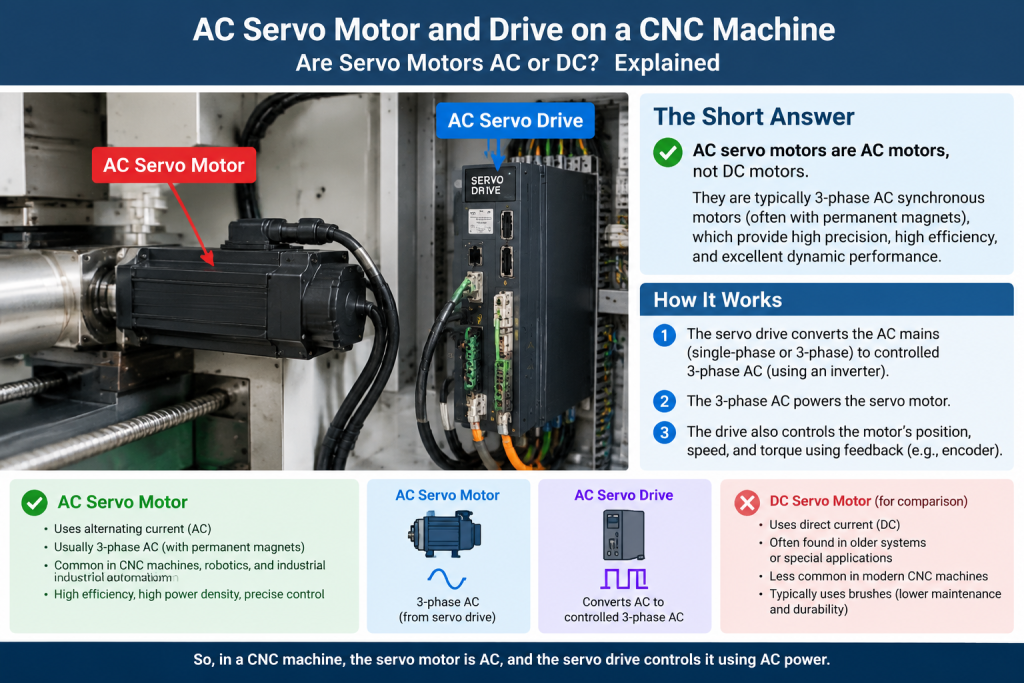
Key Takeaways
| Question | Short answer |
|---|---|
| Are most servo motors AC or DC? | AC — nearly all new industrial servo systems are AC |
| Where do DC servos still appear? | Legacy machines, small instruments, battery-powered devices |
| Can I swap AC for DC? | No — the drive, feedback, and control loop all differ |
| What decides between them? | Maintenance model, dynamics needed, and what the machine already has |
What Makes a Motor a Servo Motor?
A servo motor is defined by its closed-loop control: an encoder or resolver reports position back to a drive, which corrects any error continuously. That feedback loop — not the motor’s power type — is what makes it a servo. Both AC and DC motors can be built this way, and both are.
What Is an AC Servo Motor?
An AC servo motor runs on a three-phase supply whose frequency the drive controls. The inverter in the drive creates a rotating magnetic field that the rotor follows — usually through permanent magnets (synchronous AC servo) or induced currents (induction servos, rarer in motion control). Almost every motion axis on modern CNC machines, robots, and packaging lines uses an AC servo: Fanuc Alpha and Alpha i motors, Yaskawa Sigma series, Mitsubishi HG/HF motors, and Siemens SIMOTICS are all AC servo families.
AC servos dominate because they combine high torque density, low maintenance (no brushes), and mature drive electronics. The drive handles the complexity; the motor itself has essentially no wearing electrical contact.
What Is a DC Servo Motor?
A DC servo motor runs on direct current: the drive varies armature voltage to control speed and position. Brushes and a commutator switch current to the windings. DC servos offer excellent low-speed smoothness and simple control electronics, which is why they were standard for decades and still run in older machines.
The trade-off is maintenance: brushes wear, commutators need inspection, and high speeds accelerate both. New DC servo sales have largely given way to AC, but the installed base keeps replacement demand alive. We covered the practical differences in more depth in our article on DC vs AC servo motors.
What Are the Key Differences Between AC and DC Servo Motors?
| Point | AC servo motor | DC servo motor |
|---|---|---|
| Power supply | Three-phase AC, drive-controlled frequency | DC armature voltage |
| Commutation | Electronic, in the drive | Mechanical brushes and commutator |
| Maintenance | Low — bearings and encoders only | Brushes and commutator wear |
| Power density | Higher torque for a given size | Lower |
| Typical use today | New machines: CNC, robotics, packaging | Legacy machines still in service |
Are Servo Motors AC or DC: Which Type Should You Choose for Your Application?
For new equipment, the industry has already voted: AC servo systems win on maintenance, power density, and drive availability. The meaningful choice appears in three situations:
- Replacing a failed DC servo — matching the existing DC system keeps the machine’s wiring, tuning, and spares strategy intact
- Battery or low-voltage equipment — DC servos still fit some mobile and instrument applications
- Budget retrofits of legacy axes — a tested used DC unit can cost far less than converting the axis to AC
If you are sizing a new axis from scratch, our guide on how to select a servo motor walks through torque, speed, inertia matching, and feedback choices.
Replacing a servo motor or drive and not sure whether your axis is AC or DC? Photograph the motor nameplate and the drive — send both to us and we will confirm the exact replacement: [email protected] or WhatsApp +86 15107352558.
How Do You Replace a Servo Motor Without Compatibility Problems?
Five checks prevent most replacement mistakes:
- Match the feedback device — encoder type, resolution, and protocol (many “identical” motors differ only here)
- Match the shaft and mounting — shaft diameter, keyway, flange, and brake presence
- Match electrical ratings — voltage, current, and winding resistance within the drive’s limits
- Check the pairing with the drive — motor and drive are tuned as a pair; mixing families usually needs retuning
- Buy tested — a load-tested used unit beats an untested “new in box” from an unknown source
We supply tested AC servo motors and drives from Fanuc, Yaskawa, Mitsubishi, and Siemens — for example a Fanuc AC servo and spindle motor set or a Yaskawa SGD7S servo driver. Browse the full motor catalog for current availability.
Frequently Asked Questions
Are servo motors AC or DC?
Both. Modern industrial servo systems are overwhelmingly AC, while DC servos persist in legacy machines and special low-voltage applications. The servo function comes from closed-loop feedback, not the power type.
Why did AC servo motors replace DC?
AC servos need no brushes or commutator maintenance, deliver higher torque for their size, and their drives became cheap and mature. Maintenance cost drove the industry-wide switch.
Can a DC servo motor run on AC?
Not directly. A DC servo needs a DC armature supply with controlled voltage and current. An AC servo drive cannot power a DC motor.
How do I know if my servo motor is AC or DC?
Read the nameplate: DC motors show armature voltage and field ratings; AC servo motors show a three-phase voltage class and usually a model number you can look up. The connected drive is the fastest tell — a drive with DC output terminals means a DC motor.
Is it safe to buy a used servo motor?
Yes, if the supplier tests winding resistance, encoder function, and bearing condition, and states the warranty. Feedback devices are the most common hidden fault — ask for an encoder test report.
Get a Tested Servo Motor or Drive
So, are servo motors AC or DC? Both — and whichever type your machine runs, the fastest fix is a compatible, tested unit. We stock 100,000+ automation parts from 20+ brands, every unit tested before dispatch, with 48-hour global shipping and no minimum order. Send the motor or drive model number: [email protected] or WhatsApp +86 15107352558.