

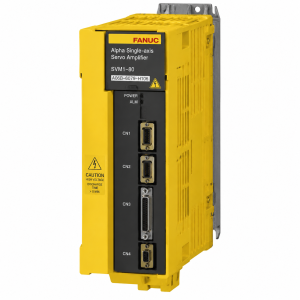
The A06B-6079-H106 is a single-axis Fanuc Alpha servo amplifier rated SVM1-80 — one axis at 80 A. It sits in the H1xx branch of the 6079 family, which means it drives exactly one servo motor, usually a larger Alpha series motor on a heavy axis. If this unit has taken your machine down, this guide will help you confirm the specs, understand what likely failed, and choose the fastest way back: repair or a tested replacement.
What Is the A06B-6079-H106?
The A06B-6079-H106 belongs to the single-axis (H1xx) side of the Fanuc Alpha 6079 servo amplifier family. The SVM1-80 rating tells you two things: one axis, and 80 A of output current. That current level puts it in front of larger Alpha series servo motors — the kind moving heavy tables, large ball screws, and high-inertia loads.
Like every amplifier in the 6079 family, it is a 200 V class module fed from a Fanuc PSM power supply module through the DC link. It does not connect to mains power on its own. If you need the bigger picture of how the H1xx, H2xx, and H3xx branches relate, our A06B series model number guide maps the whole family.
A06B-6079-H106 Specifications
| Item | Specification |
|---|---|
| Model | A06B-6079-H106 |
| Amplifier type | Fanuc Alpha SVM1-80 (single-axis servo amplifier module) |
| Rated output current | 80 A, single axis |
| Voltage class | 200 V class, DC link powered from a Fanuc PSM power supply module |
| Compatible motors | Larger Fanuc Alpha series servo motors in the 80 A class |
| Series family | A06B-6079 H1xx branch (single-axis variants) |
| Siblings | A06B-6079-H101 through H108 (single-axis), H2xx (2-axis), H3xx (3-axis) |
| Status | Legacy series — no longer in active production |
Common A06B-6079-H106 Failures We See in Our Repair Lab
A single-axis 80 A module concentrates all its stress in one power stage. After years of service, the failure patterns are predictable:
- IPM failure. Still the number one cause. On an 80 A unit driving a heavy axis, a motor with degrading insulation or a chafed power cable will destroy the power module. Test the motor and cable before installing any repaired or replacement amplifier.
- Terminal and bus bar heat damage. High continuous current through aging screw terminals creates resistance, heat, and eventually discolored or burnt connections. Inspect the DC link and motor terminals whenever the cabinet is open.
- Cooling fan failure. An 80 A power stage without airflow overheats quickly. If you hear grinding from the amplifier fan, replace it before the overheat alarms start.
- Capacitor aging. After 15–20 years, electrolytic capacitors dry out. The classic symptom: the unit faults only after warm-up, or throws intermittent alarms that clear on reset.
- Control power damage. Usually secondary damage from a failing PSM module or unstable supply. If the H106’s control section is burnt, test the PSM before reconnecting anything.
If you are mid-diagnosis on the machine, our 8 tips for troubleshooting servo motor problems covers the motor-side checks that pair with this list.
Staring at an alarm on your H106? Send us the alarm code and the amplifier’s LED status — we will tell you what it usually means and whether repair is worthwhile, free of charge. [email protected]
H1xx vs H2xx: Single-Axis or 2-Axis?
Buyers often ask whether a 2-axis unit like the H206 can replace two single-axis modules — or the reverse. The practical answer:
- They are not form-factor interchangeable. Single-axis H1xx and 2-axis H2xx modules have different widths and cabinet layouts. You cannot drop one into the other’s slot without reworking the cabinet.
- Replace what failed. If an H106 fails, source an H106. Changing architecture mid-life costs far more in labor than the part difference.
- Match the current rating. Within the H1xx branch, siblings like the A06B-6079-H104 and H105 carry lower current ratings. A lower-rated module is never a safe substitute for the SVM1-80.
One advantage of the single-axis design is granularity: one axis fails, one module comes out. When a 2-axis unit loses one channel, both axes stop. That is worth remembering when you plan spares — a single H106 on the shelf covers exactly the axis most likely to stop a heavy machine.
Repair or Replace: What Makes Sense?
| Option | Typical cost | Lead time | Best when |
|---|---|---|---|
| Repair your failed unit | Lowest — save up to 75% | 3–5 days standard | Failure is electronic (IPM, capacitors, fan, terminals) |
| Tested replacement from stock | Moderate | Ships in 48 hours | Downtime is costly, or the unit has physical damage |
| Untested surplus | Varies | Varies | Only if you can bench-test before installation |
Because the H106 drives larger motors, we always recommend checking the motor insulation and cable before any replacement goes in. Skipping that step is the main reason “new” amplifiers fail again within weeks.
A06B-6079-H106 In Stock at OUKE
We keep the A06B-6079-H106 single-axis servo amplifier in stock, bench-tested under load before it ships. Orders leave our Dongguan warehouse within 48 hours via DHL, FedEx, or UPS, with a minimum 1-year warranty and no minimum order quantity.
Prefer to repair your own unit? Standard turnaround is 3–5 working days, and our Fanuc servo repair first-pass success rate is 99.5%.
FAQ
What does SVM1-80 mean on the A06B-6079-H106?
SVM stands for Servo amplifier Module, “1” means single axis, and “80” is the rated output current — 80 A. It is one of the higher-current single-axis modules in the A06B-6079 family.
Is the A06B-6079-H106 discontinued?
Yes. The classic Alpha 6079 series is no longer in active production. Tested used, refurbished, and repaired units from specialist suppliers like OUKE are the standard sourcing route.
Can I use an H104 or H105 instead of an H106?
No. They are single-axis modules on the same platform, but with lower current ratings. Driving an 80 A-class motor with a lower-rated amplifier risks overcurrent faults and IPM damage.
My H106 faults only after the machine warms up. Why?
Heat-dependent faults usually point to aging electrolytic capacitors or a weak cooling fan. Both are inexpensive repairs — but continued operation risks far costlier power-stage damage.
Should I test the motor before installing the replacement?
Yes, always. On 80 A applications, a degraded motor or damaged cable is the leading root cause of amplifier failure. Megger the motor windings and inspect the power cable first.
Get Your A06B-6079-H106 Back Running Fast
Need a tested A06B-6079-H106 or a repair quote for your failed unit? We have 100,000+ SKUs in stock, all tested, shipped within 48 hours — no MOQ. Send us your part number: [email protected] or WhatsApp +86 15107352558.