

FANUC BiSVSP Servo Amplifiers
What BiSVSP Servo Amplifiers Do
FANUC BiSVSP servo amplifiers are critical components in industrial automation systems. They control the power supplied to servo motors, enabling precise motion control for CNC machines, robotics, and other automation setups. These amplifiers translate control signals into motor movements, ensuring smooth, accurate, and reliable operation.
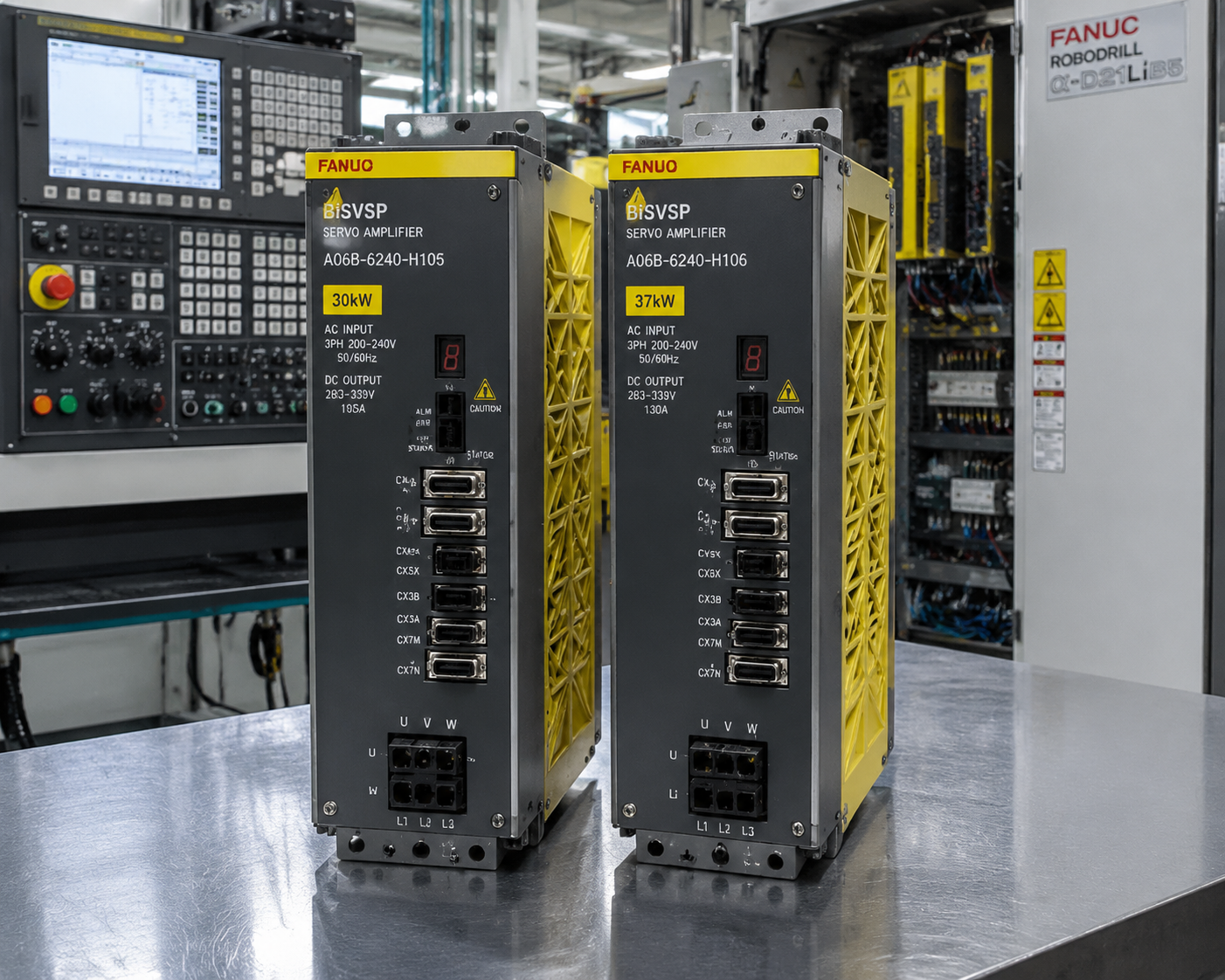
Why A06B-6240-H105 and A06B-6240-H106 Get Compared
The comparison between A06B-6240-H105 and A06B-6240-H106 is important because these models are part of FANUC’s BiSVSP series, designed for different power and application requirements. Choosing the right model ensures optimal performance, system compatibility, and longevity—especially in high-demand environments.
Who This Comparison Helps
This comparison is ideal for engineers, technicians, and procurement teams—anyone tasked with selecting, replacing, or upgrading FANUC servo amplifiers. Whether you’re fine-tuning a small CNC setup or managing heavy-duty industrial automation lines, understanding the differences helps make informed decisions to match your machine’s needs.
A06B-6240-H105 Specs
Power Rating and Output Details
The FANUC A06B-6240-H105 servo amplifier is designed for moderate to high-precision applications, offering a power rating typically around 2.4 kW. It provides smooth and reliable servo control for a variety of CNC machine setups, making it a popular choice for smaller and medium-sized manufacturing projects.
Voltage and Current Requirements
This model operates on a standard 200-240V AC input, supporting both single-phase and three-phase power supplies depending on the system. Its current draw aligns with its power rating, generally around 6-8A during operation, ensuring it fits well within typical machine electrical systems without requiring heavy-duty power sources.
Supported Motor Types and System Compatibility
The H105 is compatible with FANUC’s BiSVSP servo motors and can be integrated into various CNC and industrial automation systems. It supports servo motors with a maximum rated voltage of approximately 200V and is often used with FANUC’s standard servo motor series, ensuring seamless communication with FANUC controllers.
Size, Weight, and Cooling Method
In terms of physical specs, the H105 model is compact, designed to fit into small footprint control panels—ideal for tight spaces. It weighs roughly 3-4 kg (6.6-8.8 lbs) and features a convection cooling system. This allows for straightforward installation without the need for complex heat dissipation setups, making maintenance easier.
Best-Fit Use Cases and Application Limits
The A06B-6240-H105 is best suited for smaller CNC machines, robotics, and high-precision automation setups where moderate power and compact size are essential. It’s ideal for applications requiring smooth velocity control, such as small milling machines or precision positioning tasks. However, it has limits when handling very high torque loads or demanding industrial environments that require more robust cooling and power capabilities.
If you’re considering specific applications or need to ensure compatibility, it’s helpful to compare these specs against your existing setup or planned upgrade, and for extra guidance, OUKE’s support team can assist in matching parts accurately.
A06B-6240-H106 Specs
The A06B-6240-H106 differs from its H105 counterpart with a higher power rating and enhanced capabilities. Its power output is suitable for more demanding applications, making it ideal for larger CNC machines or heavy-duty automation setups. Typically, this amplifier supports a broader range of motor types and can handle higher loads, which is crucial for systems requiring robust performance.
Voltage requirements for the H106 generally align with standard FANUC servo systems but may demand slightly higher input voltages for optimal operation. Its current capacity is also increased, allowing for better handling of motor startup and peak torque demands. For detailed specs, it’s best to check the official datasheet, but expect higher ratings in both voltage and current compared to the H105.
In terms of compatibility, the H106 supports a wide array of FANUC motors and can integrate smoothly with most FANUC CNC controllers. Its size and weight are slightly larger, which is worth considering if space is tight. The cooling method mainly relies on air cooling, but some setups might benefit from additional ventilation or liquid cooling for extended use.
When it comes to application limits, the H106 is best suited for larger or more power-intensive systems—think heavy machinery, robot arms, or aerospace manufacturing. It can handle higher loads and more rigorous use cases, but it’s also more demanding in terms of installation and maintenance. This makes it essential to match the specs carefully to your system requirements. For a detailed comparison and compatibility tips, visiting FANUC servo amplifier technical specs can be helpful.
H105 vs H106 Comparison: BiSVSP Servo Amplifier Specs
Here’s a quick side-by-side look at the differences between the FANUC A06B-6240-H105 and H106 digital servo amplifiers. Understanding these specs helps you pick the right model for your specific needs.
Key Specifications Comparison Table
| Feature | A06B-6240-H105 | A06B-6240-H106 |
|---|---|---|
| Power Rating | 3.0 kW / 4.0 kVA | 5.0 kW / 6.0 kVA |
| Voltage Requirements | 200-240 VAC, single-phase or three-phase | 200-240 VAC, three-phase |
| Max Current | 20A | 30A |
| Supported Motors | Standard servo motors | Heavy-duty or high-torque motors |
| Size | Smaller footprint, lightweight | Slightly larger, more robust |
| Cooling Method | Convection cooling | Water-cooled options available |
| Best For | Smaller CNC, light automation tasks | Heavy-duty automation, high-demand setups |
Performance Differences in Real Use
The H105 is great for smaller CNC machines or projects with moderate power needs. It’s lightweight and compact, making it easy to fit into tight spaces. On the other hand, the H106 handles higher loads smoothly, suited for industrial lines or robotics that demand more torque and current.
Compatibility with FANUC Controllers and Motors
Both models are compatible with most FANUC CNC controllers and servo motors, but the H106’s higher power capacity makes it a better fit for high-performance setups. Always double-check your specific system’s specs when choosing, as servo driver compatibility is key to smooth operation.
Which Model Fits Your System?
- Compact systems: H105 works better due to its smaller size and lower power output.
- High-demand setups: H106 is the better choice if you’re running heavy-duty machines or need more torque and current capacity.
In short, choose based on your application’s load requirements, space constraints, and future scalability. Both are reliable options in the FANUC A06B-6240 series but serve different needs.
Application Differences of FANUC A06B-6240-H105 vs H106
The choice between the FANUC BiSVSP servo amplifiers H105 and H106 really depends on your specific application needs. Here’s how they stack up across common use cases:
Smaller CNC Machine Setups
- H105 is ideal for compact CNC machines due to its smaller size and simpler cooling requirements.
- It offers enough power for smaller machines where space and energy efficiency matter.
- Typically, it handles light to moderate loads, making it perfect for hobbyist or small manufacturing setups.
Heavy-Duty Industrial Automation Lines
- H106 shines in heavy-duty automation systems that demand higher power and reliability.
- It supports larger motors and can handle more demanding loads without overheating or performance loss.
- Suitable for large CNCs, robotic arms, or production lines where continuous operation is critical.
Robotics and Precision Motion Control
- Both models can be used in robotics, but H106 often provides more precise control with higher current capacity.
- When working with advanced robotics requiring high torque and tight motion control, H106 is the better fit.
Manufacturing, Automotive, and Aerospace Uses
- For high-precision manufacturing, H106 offers better stability and power handling.
- It’s favored in aerospace and automotive industries for demanding applications that require consistency and durability.
- H105 can serve lighter applications like general assembly or smaller component machining.
Replacement and Retrofit Scenarios
- H105 is often used as a cost-effective replacement for older, lower-capacity amplifiers in smaller systems.
- H106 fits better when upgrading existing systems that need higher power and more robust performance.
- Always check system compatibility, especially with controller models, before swapping.
| Application Area | Best fit: H105 | Best fit: H106 |
|---|---|---|
| Small CNC machines | Yes | No |
| Heavy-duty automation | No | Yes |
| Robotics/precision | Moderate | High |
| Manufacturing/automotive | Light/medium | Heavy/robust |
Choosing the right amplifier depends on your system’s size, load demands, and future expansion plans. If you want to be sure you get the best match, consult with experts at OUKE CNC for personalized advice on compatibility and installation.
Compatibility and Replacement Checks
Matching the right FANUC BiSVSP servo amplifier, like the A06B-6240-H105 or A06B-6240-H106, to your system is crucial for smooth operation. First, always verify your controller’s compatibility. The H105 and H106 often have different features, so double-check that your FANUC CNC controller supports the specific amplifier model you plan to install.
Next, match your servo motor specifications carefully. Look at the motor’s voltage, current, and type to ensure they align with the amplifier’s output. You can usually find this info on your motor label or in your machine’s documentation. For detailed guidance on matching servo motors and amplifiers, I recommend consulting an expert guide.
Always check the part number and revision details before ordering or swapping amps. Small revisions can sometimes cause compatibility issues, so matching the exact part number is safest. Remember, using the wrong amplifier can lead to performance drops or even equipment damage.
Be aware of common fit issues, such as mounting holes or connector differences. The H106 is generally suited for higher-demand setups, so if your system is more compact or lighter-duty, the H105 might be a better fit.
When considering a replacement or upgrade, ask yourself: Is this upgrade compatible with my existing controller and motor? If not, a reconfiguration could lead to issues. It’s best to consult with a professional or a trusted supplier to avoid situations where the swap isn’t safe or practical. Proper compatibility checks save time, reduce downtime, and extend your system’s life.
Installation and Setup of FANUC BiSVSP Servo Amplifiers
Getting your FANUC A06B-6240-H105 or H106 servo amplifier installed involves a few key steps. First, make sure to follow the proper wiring and mounting procedures. Both models have specific mounting dimensions and cooling needs, with the H106 generally requiring more robust cooling solutions due to its higher power capacity. Proper ventilation is crucial to keep the amplifier from overheating during operation.
Before powering up, perform safety checks—inspect all wiring connections for tightness, ensure no loose cables, and verify that the system is grounded correctly. An improper setup can lead to electrical faults or damage.
Cooling and ventilation tips are vital, especially for the H106 model, which handles higher loads. Keep the amplifier in a well-ventilated area, and consider supplemental cooling if operating in a hot environment. This helps prolong the unit’s life and maintains stable performance.
When starting the system for the first time, double-check all your connections and ensure compatibility with your FANUC controller and motor setup. Loose or mismatched wiring can cause issues like erratic motor behavior or amplifier faults.
Lastly, avoid some common setup mistakes:
- Overlooking grounding requirements
- Connecting incompatible motors or controllers
- Forgetting to configure the amplifier’s parameters properly
- Failing to follow manufacturer safety guidelines
A proper setup can save you troubleshooting time later. For detailed wiring diagrams and setup procedures, you may find helpful guides on FANUC amplifier installation.
Troubleshooting and Maintenance for FANUC BiSVSP Servo Amplifiers
When dealing with FANUC BiSVSP servo amplifiers like the A06B-6240-H105 or A06B-6240-H106, understanding common errors and maintenance tips can save a lot of downtime.
Common FANUC servo amplifier errors
Some typical errors include overcurrent alarms, overheating warnings, communication faults, or motor stalls. These issues often originate from wiring problems, component wear, or system mismatches. Regularly checking error codes through your FANUC controller can help you pinpoint the root cause quickly.
What to check when performance drops
If your CNC machine or automation setup starts acting sluggish or unstable, consider:
- Inspecting wiring connections for looseness
- Verifying cooling system efficacy (fans, heat sinks)
- Ensuring the motor load isn’t exceeding specs
- Reviewing recent system updates or changes
- Checking power supply stability
Basic maintenance to extend service life
To keep your FANUC amplifier running smoothly:
- Keep vents and cooling fans clean
- Regularly inspect for signs of overheating or dust buildup
- Tighten loose connections
- Check the system’s temperature sensors and fan operation
- Use reputable replacement parts if needed—refurbished FANUC servo amplifier replacement options can be a cost-effective choice
Signs of wear, overheating, or mismatch
Watch for unusual vibrations, inconsistent motor response, or frequent resets. Overheating might show as burnt smell or discoloration on the amplifier chassis. A mismatch between the amplifier and motor, or using an incompatible model like H105 vs H106, can cause performance issues, so double-check compatibility before making repairs or replacements.
When to replace instead of repair
If your FANUC BiSVSP servo amplifier shows persistent errors despite troubleshooting or has significant physical damage, it’s usually better to replace. Repairing can be complex and sometimes more costly than a new or refurbished unit, especially when avoiding unexpected downtime. Always verify model compatibility and system requirements before installing a new amplifier.
Maintaining your FANUC servo amplifiers proactively keeps your CNC machines running at peak performance, whether you’re managing smaller setups or high-demand industrial automation lines. Regular checks and knowing when to replace can make all the difference in avoiding costly downtime.
Buying Guide for FANUC Servo Amplifiers: Choosing Between H105 and H106
When you’re trying to decide between the FANUC A06B-6240-H105 and A06B-6240-H106, it all comes down to understanding what your specific application needs. Both are BiSVSP servo amplifiers, but they have different strengths and specs suited for different setups.
What Specs Matter Most for Your Job
Focus on these key specs:
- Power & load capacity — H106 offers higher power handling, ideal for heavy-duty applications.
- Size and mounting — H105 is more compact, making it a good fit for tight spaces or smaller CNCs.
- Compatibility — Match the amplifier with your FANUC controller model and motor type. Check servo amplifier technical specs to ensure perfect fit.
- Cooling and ventilation — Determine if your system requires active cooling (H106) or if passive cooling suffices (H105).
Cost and Value Considerations
- H105 usually costs less, making it suitable for less demanding setups or retrofit projects.
- H106 might come at a higher price but provides more robust performance for higher-demand setups like robotics or large automation lines.
- Think about the total cost of ownership, including potential repairs or replacements.
New, Used, and Replacement Options
- OEM new parts guarantee compatibility but come with a premium price.
- Used or refurbished units can save money, but you’ll want to verify their test history and warranty.
- When replacing, double-check part numbers and system compatibility to avoid fit issues. For guidance, see how to match the right amplifier to your system.
How to Reduce Downtime with the Right Part
- Properly identify your current amplifier’s model and revision.
- Ensure wiring and mounting are correct to prevent damage.
- Follow safety and startup procedures closely, including cooling checks.
- Regular maintenance can extend your amplifier’s life and keep your CNC or automation line running smoothly.
In short, your choice between the H105 and H106 hinges on your equipment’s power needs, space constraints, and budget. Evaluating these specs against your application’s demands will help you minimize downtime and maximize performance. For more on matching parts, check out our CNC system parts page.
OUKE Support
At OUKE, we understand that choosing the right FANUC servo amplifier, like the A06B-6240-H105 or H106, is crucial for your automation setup. Our team offers expert guidance on specs, compatibility, and sourcing to make sure you get the best fit for your CNC machine or industrial automation system. Whether you’re upgrading existing equipment or sourcing replacements, we help match the right BiSVSP servo amplifier to your controller and motor needs, avoiding costly mismatches.
We also assist with specification checks and compatibility verification, ensuring seamless installation and operation. Plus, our support includes help with procurement—finding trusted parts quickly, whether new, used, or refurbished—so your downtime is minimized. From technical advice to part sourcing, OUKE is committed to helping you keep your FANUC CNC systems running smoothly.