

Rack or Chassis: Backbone of GE PLC Modular Architecture
The rack or chassis serves as the fundamental backbone for any programmable logic controller (PLC) system. It physically houses and connects all the essential PLC hardware components, including the CPU, power supply modules, signal modules, and communication processors. More than just a frame, the rack facilitates communication between these modules, ensuring smooth data and control signal exchange throughout the system.
When working with GE PLC modules, particularly the GE Fanuc Series 90-30 and 90-70 platforms, understanding the rack’s role is crucial. These racks are designed for scalability and robust industrial performance, accommodating multiple slots to fit diverse modules according to your application’s size and complexity.
-
GE Series 90-30 Rack:
This rack supports up to 14 slots, allowing for flexible expansion of CPU, input/output (I/O), and specialty modules. It’s perfect for mid-range automation where modularity is key. The backplane ensures stable power distribution and reliable data communication among modules.
-
GE Series 90-70 Rack:
Larger and more scalable, the 90-70 rack can handle up to 20 slots. It’s engineered for high-demand industrial environments requiring extensive I/O integration and multi-rack communication. Its rugged design supports takt times in complex control processes without compromise.
Both rack types use a common bus architecture, allowing GE’s modular PLC hardware components to plug and play seamlessly. This structured approach simplifies system upgrades and maintenance, providing you with a flexible foundation tailored to your control system needs.
Whether you’re optimizing existing equipment or designing a new control solution, selecting the right rack is step one. It determines your system’s scalability, module compatibility, and overall robustness—critical factors for industrial automation success.
Power Supply (PS) Module in GE PLCs
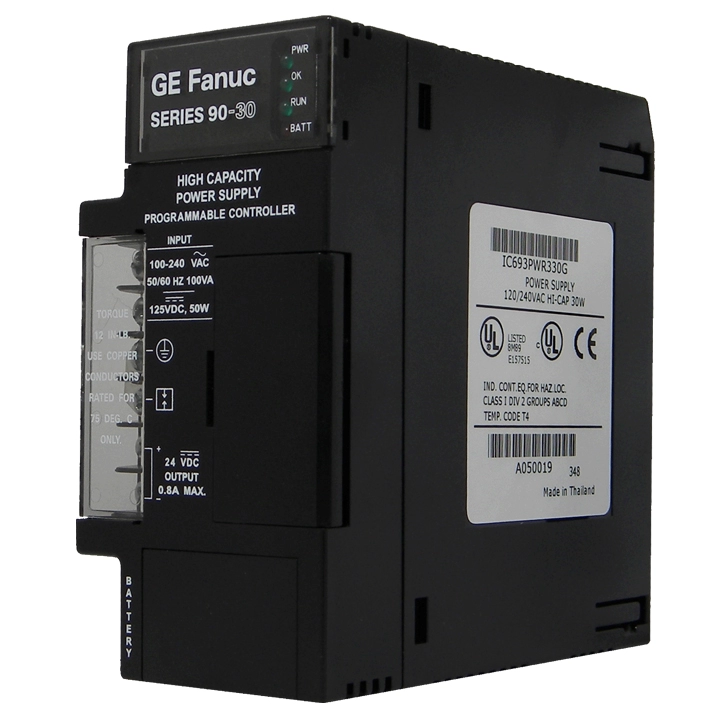
The Power Supply (PS) Module is essential in any PLC system, converting incoming AC or DC power into stable, reliable voltages that the CPU and all I/O modules depend on. Without a steady power source, the entire PLC system risks malfunction or failures. GE’s IC693PWR series power supply modules are popular choices in industrial environments for their reliability and efficiency.
Key features of GE IC693PWR power supplies include:
- Wide input voltage range to handle fluctuating industrial power supplies
- Overcurrent and short-circuit protection for safe operation
- Status LEDs for easy monitoring
- Compatibility with GE Fanuc Series 90-30 PLC racks, ensuring seamless integration
When selecting a power supply module for your GE PLC, consider:
- The total power consumption of your CPU and I/O modules
- The environmental conditions like temperature and electrical noise
- Scalability options if your system may grow in the future
Choosing the right GE power supply module ensures your PLC’s backbone remains stable and operational, avoiding unexpected downtime in critical automation processes. For a closer look at GE CPU modules that pair with these power supplies, check out this Fanuc A20B-3300-0101 CPU card.
Central Processing Unit (CPU)
The Central Processing Unit (CPU) is the brain of any PLC system, responsible for processing logic, managing input/output (I/O) operations, and executing control tasks. In the GE Fanuc Series 90-30 modules, the CPU handles complex automation processes efficiently, making it a reliable choice for various industrial applications.
GE’s Series 90-30 CPUs come with advanced features like built-in Ethernet ports, allowing seamless network communication for remote monitoring and control. They also support motion control functions, making them perfect for applications that require precise motor management and synchronization.
These CPUs can handle high-speed data processing and offer scalability options, so you can expand your system without hassle. With robust performance and flexibility, GE’s CPU modules fit well in both small-scale and complex automation setups.
For those looking for detailed specs and options, GE Emerson PLC modules provide a range of CPU models tailored to different needs, ensuring you get the right balance between power and cost. Check out the lineup to see which Series 90-30 CPU best suits your project and industrial environment.
4. Interface Module (IM)
The Interface Module (IM) is essential for linking multiple racks or chassis in a large PLC modular architecture. It enables smooth communication and data exchange between different PLC racks, expanding system capacity without sacrificing speed or reliability. GE’s use of Interface Modules, particularly in their Series 90-30 and 90-70 systems, supports complex, multi-rack setups that are common in industrial automation environments.
Interface Modules are especially valuable when connecting remote I/O stations to the main CPU rack, helping centralize control while distributing input/output across a broad area. This setup reduces wiring complexity and improves maintenance efficiency.
For companies using GE PLC modules, leveraging the IM means scalable expansion, easier system upgrades, and flexible networking. This capability is critical for industries looking to grow their automation systems adaptively, with minimal downtime or hardware overhaul.
By incorporating these modules, you ensure your GE PLC setup can handle large applications and demanding process controls effectively.
See similar networking requirements on advanced Siemens communication modules like the Siemens 6GK1503-3CC00, which also support industrial communication expansion.
5. Signal Module (SM)
Signal Modules (SM) in a PLC manage the digital and analog input/output signals, acting as the bridge between the PLC and field devices like sensors and actuators. These modules handle everything from simple ON/OFF digital signals to complex analog signals such as temperature, pressure, or flow readings.
GE’s signal module lineup within the GE Fanuc Series 90-30 and Emerson PACSystems PLCs covers a broad range of digital and analog I/O options designed for reliability and precision. Digital signal modules often support high-speed counting and pulse outputs, perfect for monitoring machine status or controlling devices. On the analog side, GE offers modules capable of handling voltage, current, and thermocouple inputs to ensure accurate data collection from industrial sensors.
With GE PLC hardware components, you can easily integrate various sensors and actuators across manufacturing and automation systems, maintaining real-time control and feedback. Whether you need to process simple proximity sensor signals or complex analog data streams, GE’s modular PLC I/O lineup supports scalable, flexible solutions.
For advanced industrial Ethernet networking supporting diverse module types, check out high-performance options like the Siemens Simatic Net Scalance X Industrial Ethernet Switch, often used alongside GE modules for robust communication infrastructure.
In , Signal Modules are key in linking PLC logic to the physical world, with GE’s digital and analog modules offering dependable options for a wide variety of sensor and actuator integration needs.
Function Modules (FM) for Specialized Control Tasks
Function Modules (FM) in a PLC setup handle specialized operations that go beyond basic input/output processing. These modules focus on tasks like high-speed counting, PID (Proportional-Integral-Derivative) control for precise process adjustments, and motion control critical in automation systems.
GE’s function modules, especially within the GE Fanuc Series 90-30 modules, include high-speed counters designed for accurate event counting in fast-paced industrial environments. Their motion control modules support precise positioning and speed regulation, essential for robotics, conveyor belts, and CNC machinery.
Using these modules lets you tap into advanced control features without overloading the CPU, giving smoother operation and better performance in demanding production settings.
Key benefits of GE Function Modules:
- High-speed counting accuracy for fast signals
- PID control for maintaining process stability
- Motion control integration for precise mechanical movements
- Offload complex tasks from the main CPU for efficiency
If your project requires tight control with real-time adjustments or complex motion tasks, investing in GE’s function modules enhances reliability and output quality in your automation system.
Communication Processor (CP) Module: Networking and Protocol Integration
The Communication Processor (CP) module plays a crucial role in connecting GE PLCs to networks and industrial communication protocols like Ethernet/IP, Modbus, and Profibus. This module enables seamless data exchange between the PLC and other devices or control systems, supporting modern Industry 4.0 integration. GE’s CP modules, including Ethernet and Genius Bus options, are designed to handle high-speed data transfer and link multiple PLC racks or remote I/O devices efficiently.
With GE Fanuc Series 90-30 and 90-70 systems, CP modules expand your system’s capability to communicate within a plant network or connect to supervisory control and data acquisition (SCADA) systems. These modules ensure robust networking for scalable automation setups, critical for industries focusing on real-time monitoring and distributed control.
Key benefits of GE Communication Processor modules:
- Support for major industrial communication protocols
- High-speed data handling for time-sensitive applications
- Integration with Ethernet for Industry 4.0 connectivity
- Enhanced link between multiple racks and remote devices
For US-based manufacturing setups aiming at smart factory solutions, GE’s CP modules offer reliable industrial communication integration, allowing your PLC to talk smoothly with a range of devices and enterprise systems.
To explore similar industrial communication module options, check out Siemens Simatic S7-1200 PLC for comparable networking capabilities within the modular PLC market.
GE PLC Modules Specific Insights and Comparison
GE Fanuc’s legacy PLC modules, now part of Emerson’s PACSystems line, are known for their robust design and flexible modular architecture. They offer a broad variety of modules, from basic digital and analog I/O to advanced motion and communication processors.
| Feature | GE Fanuc / Emerson PACSystems | Siemens (S7 Series) | Allen-Bradley (ControlLogix) |
|---|---|---|---|
| Module Variety | Wide range: CPU, PS, IM, SM, FM, CP | Extensive, high customization | Broad, industrial-strength modules |
| Robustness | Industrial-grade, proven in harsh environments | High durability, specialized for automation | Excellent reliability and support |
| Scalability | Multi-rack systems with interface modules | Modular and scalable systems | Scalable, with distributed I/O options |
| Communication Support | Ethernet/IP, Modbus, Profibus via CP modules | ProfiNet, Ethernet | Ethernet/IP, DeviceNet, ControlNet |
| Motion Control | Integrated motion modules available | Advanced motion control | Industry-leading motion options |
These GE PLC modules shine in scenarios where expansion and system stability are key, particularly with their proven 90-30 and PACSystems platforms. When compared to Siemens and Allen-Bradley, GE’s modules often provide a cost-effective middle ground with solid performance, especially in U.S. industrial settings.
For those familiar with PLC modular architecture, GE’s approach balances functionality and ruggedness, making it a reliable choice for automation professionals looking for adaptable hardware without overpaying.
Check out related insights on industrial automation for more context on how these modules fit within modern manufacturing environments.
Choosing the Right PLC Modules for Your Application
Selecting the right PLC modules is crucial to building a reliable and efficient control system tailored to your needs. When working with GE PLC modules, consider these key factors:
- I/O Needs: Determine how many digital and analog inputs/outputs your system requires. GE offers a diverse lineup of signal modules (SM), making it easy to find the right fit for sensors, actuators, and other field devices.
- Environment: Understand your operational conditions—temperature ranges, vibration, and electromagnetic interference can impact module choice. GE’s rugged IC693 series power supply modules and CPUs are designed for industrial environments, ensuring stable performance.
- Processing Speed & Functionality: Advanced applications might need high-speed counters or motion control, so incorporating the right function modules (FM) and CPUs with Ethernet support is important. GE’s Series 90-30 and PACSystems CPUs offer scalable performance options to match.
- Expansion & Communication: Plan for growth. Interface modules (IM) and communication processors (CP) from GE allow multi-rack expansion and seamless networking using protocols like Ethernet/IP and Modbus, supporting Industry 4.0 connectivity.
- Cost vs. Compatibility: Balance your budget with future-proof compatibility. GE Fanuc Series 90-30 modules are known for their robustness and long-term availability, providing good value in large-scale industrial setups.
By carefully evaluating these points, you can ensure you pick the right GE PLC hardware components that fit your application perfectly—whether you need modular flexibility or a compact solution.
For more insights on PLC hardware components and maintenance, you might find this guide on common maintenance problems of Mitsubishi servo drive modules helpful, as it touches on related industrial automation components relevant to system reliability.