

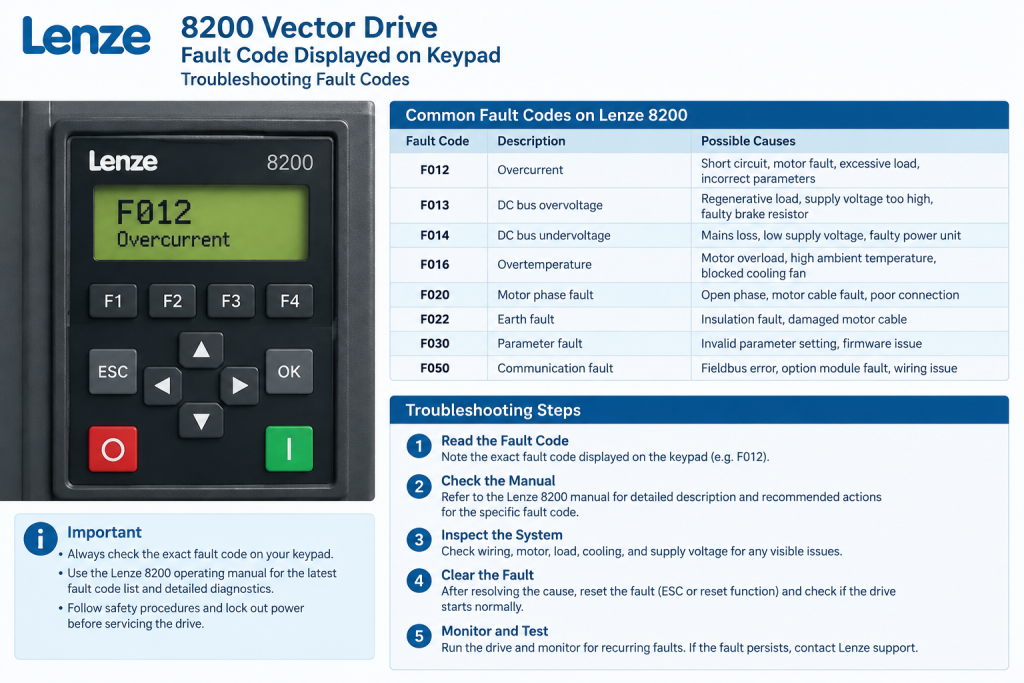
A Lenze drive fault code on the display is the drive’s way of telling you exactly why it stopped. Read the code correctly and most faults clear in minutes; ignore the pattern behind repeated codes and you will fight the same shutdown every week. This guide covers the most common Lenze VFD fault codes on the 8200 vector and AC Tech (SMVector) families — the same protections the AC Tech fault codes report, with different labels — how to reset them properly, what the “AS-LC automatic start inhibited” status means, and when a repair makes more sense than another reset.
Key Takeaways
| Code family | Meaning | First check |
|---|---|---|
| OC1 / OC2 | Overcurrent — short circuit or ground fault | Motor cable and insulation |
| OE | DC bus overvoltage | Deceleration ramp, braking resistor |
| LU | DC bus undervoltage | Supply voltage and fuses |
| OH | Heatsink over-temperature | Fan, filters, cabinet temperature |
| AS-LC | Automatic start inhibited | Inhibit input wiring and start conditions |
Exact codes vary by series and firmware — always confirm against the manual for your specific unit.
What Are Lenze Drive Fault Codes?
Lenze drives protect themselves by monitoring current, voltage, temperature, and internal states continuously. When a monitored value leaves its safe window, the drive switches off its output and shows a fault code — a two-letter code on the basic LED display of an 8200 vector, or a numbered message on keypad-equipped units. The drive also stores the fault history, so the last several faults are retrievable even if the display has been reset.
That history matters more than the live code. One OE after a fast stop is a settings question; OE three times a day points at a braking resistor or ramp problem. Pull the history before you clear anything.
What Do the Common Lenze VFD Fault Codes Mean?
| Code | Meaning | Usual root cause |
|---|---|---|
| OC1 | Overcurrent, instantaneous | Short circuit, output cable damage, motor winding fault |
| OC2 | Overcurrent, ground fault | Insulation breakdown in motor or cable to ground |
| OE | DC bus overvoltage | Deceleration too fast, missing or failed braking resistor |
| LU | DC bus undervoltage | Supply sag, blown fuse, contactor dropping out |
| OH | Heatsink over-temperature | Blocked filters, failed fan, hot cabinet |
| EE | External fault | Wired external fault input triggered by another device |
OC1 and OC2 deserve respect: do not just reset them repeatedly. Measure motor insulation and check the cable before the next start, or the drive’s output stage will eventually fail for real. If the output section is already damaged, a load-tested replacement 8200 vector unit from stock is usually faster than a repair cycle.
How Do You Clear a Lenze Fault Properly?
- Record the code and the fault history before resetting — once cleared, the evidence is harder to read
- Remove the cause — a reset without fixing the cause just schedules the next stop
- Reset via keypad (RESET key / menu) or terminal, depending on your unit’s configuration
- Or power-cycle the drive if no keypad is fitted — most Lenze units reset on power-up unless the fault is still active
- Watch the first restart — current, DC bus voltage, and temperature readings during the first minutes tell you whether the fix held
If the same code returns immediately at every start, stop cycling the drive and move to diagnostics or repair — repeated fault resets stress the output stage.
What Does “AS-LC Automatic Start Inhibited” Mean on a Lenze 8200?
AS-LC is a status, not a fault: the drive is healthy, but it is refusing to start because a configured start condition is not met. The most common causes:
- An inhibit input is active — terminals wired as inhibit (enable) are open or reading low; check the terminal wiring and the 24 V logic supply
- Start conditions not satisfied — the drive waits for a combination of terminals or a bus command that has not arrived
- Automatic restart logic — after a power dip, some configurations hold the drive in inhibit until conditions clear
- Configuration mismatch — after a parameter upload or replacement drive, the terminal assignment may differ from the old unit
Diagnose it in order: measure the inhibit/enable terminals, compare the terminal configuration against a known-good unit or backup, and only then touch parameters. [需核实: 具体端子号和参数位随 8200 子型号不同,按现场手册核对]
When Should You Repair a Lenze Drive Instead of Resetting It?
Three patterns say the drive itself needs attention:
- The same fault returns after a correct fix — the monitoring circuit or output stage may be marginal
- No-output or distorted output with no active fault code — failed output devices often trip monitoring late
- Dead display or failed keypad — power supply or communication boards inside the drive
Lenze drives are repair-friendly, and repairs typically cost a fraction of a new unit — our team repairs and load-tests drive units before they ship back. The alternative when a line cannot wait is a tested replacement: we stock Lenze 8200, i550, and 8400 families — see the Lenze parts catalog and the i550/8400 vector inverter listing for typical availability.
Fighting a repeating Lenze fault code and not sure whether it’s the drive, the motor, or the parameters? Send us the code, the drive model, and what the machine was doing when it tripped: [email protected] or WhatsApp +86 15107352558.
How Do You Prevent Repeat Lenze Faults?
- Keep the cooling path clean — filters and fans are the difference between OH once a year and OH every shift
- Back up parameters after every commissioning — a saved parameter set turns a drive swap into a ten-minute job
- Check the braking resistor circuit on high-inertia loads — OE faults usually trace back here
- Log recurring codes with timestamps — patterns (load-dependent, heat-dependent, after power events) point straight at the root cause
For background on the drive family itself, read our introduction to Lenze servo inverters.
Frequently Asked Questions
How do I find Lenze fault code meanings?
The drive manual for your exact series lists every code; the drive display and stored fault history show the active and previous codes. Common codes like OC1 (overcurrent), OE (overvoltage), LU (undervoltage), and OH (over-temperature) are consistent across most Lenze families.
What is the difference between Lenze 8200 and SMVector fault codes?
The 8200 vector uses short letter codes on its LED display, while AC Tech SMVector units show numbered codes on their keypad. The underlying protections are similar — overcurrent, overvoltage, undervoltage, and over-temperature — but the code lists differ, so use the manual matching your unit.
Why does my Lenze drive keep showing OC1 at startup?
Startup OC1 usually means a real output problem: shorted motor cable, failed motor winding, or a damaged output stage in the drive. Check motor insulation and cable before further resets; if the drive itself has failed output devices, repair or replacement is the fix.
What does automatic start inhibited mean?
AS-LC means the drive is running normally but a start condition is not met — an inhibit input is open, or the configured start logic has not been satisfied. Check terminal wiring and the enable chain first.
Is it worth repairing an old Lenze 8200?
Yes, in most cases. The 8200 family is repair-friendly, parts remain available, and a tested repair typically costs much less than a new drive plus re-engineering — as long as the motor and application still suit the platform.
Fix Your Lenze Drive Fast
Whether you are reading Lenze VFD fault codes on a down line or planning a repair, we can help. We stock 100,000+ automation parts from 20+ brands, every unit tested before dispatch, with 48-hour global shipping and no minimum order. Send the drive model and fault code: [email protected] or WhatsApp +86 15107352558.