

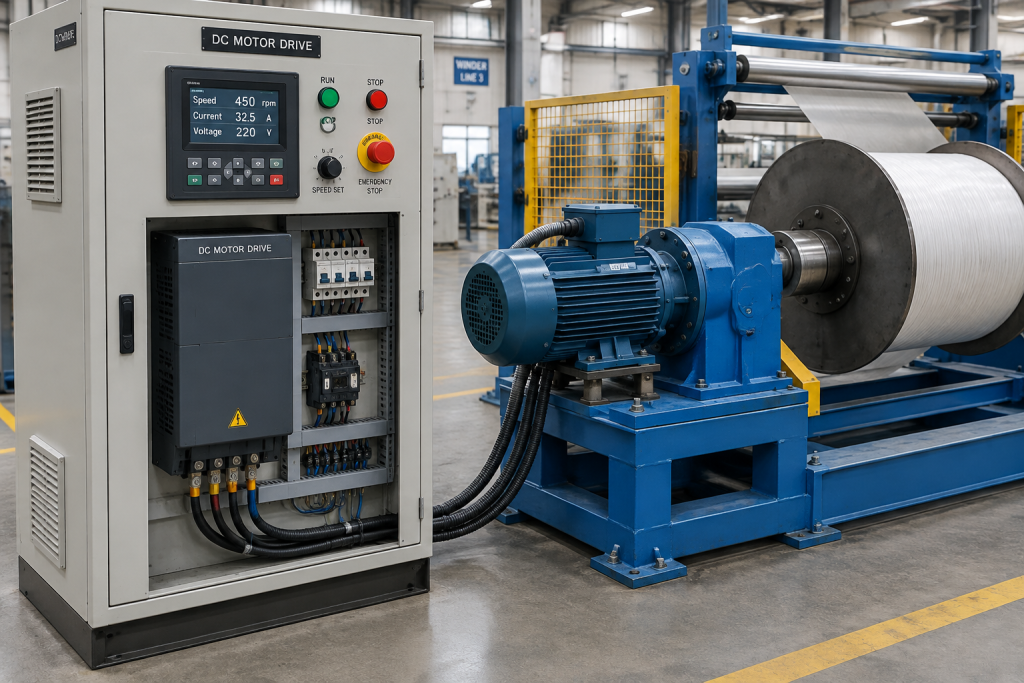
A DC motor drive controls the speed and torque of a DC motor by regulating the voltage and current fed to its armature and field windings. DC drives are old technology by automation standards — but they are far from dead. Large numbers still run wounders, extruders, hoists, and legacy production lines where replacing the motor and drive together is too costly to justify. This guide explains how DC drives work, which type fits which application, and what to check before you buy a replacement.
Key Takeaways
| Question | Short answer |
|---|---|
| What does a DC drive control? | Armature voltage (speed) and field current (torque) of a DC motor |
| When is DC still the right choice? | Legacy DC motors in good condition, high starting torque, or tight speed regulation at low cost |
| What are the main types? | Analog, digital, and regenerative (4-quadrant) drives |
| What kills most DC drives? | Dust, heat, and aged capacitors — preventable in most panels |
What Is a DC Drive and How Does It Work?
A DC drive is a power electronic controller that converts incoming AC supply into adjustable DC output. Inside a typical unit:
- Rectifier stage — converts AC line power to DC (thyristors or diodes, depending on design)
- DC bus — smooths the DC with capacitors or inductors
- Armature control — adjusts the voltage applied to the motor’s armature; speed follows voltage almost linearly
- Field supply — regulates field current to set torque characteristics
Because speed responds almost linearly to armature voltage, DC drives give smooth, predictable control over a wide speed range — one reason they stayed standard on winders and extruders for decades.
What Are the Main Types of DC Drives?
| Type | How it controls | Best for |
|---|---|---|
| Analog DC drive | Potentiometers and analog setpoints | Older machines; simple speed control |
| Digital DC drive | Keypad parameters, fieldbus, and diagnostics | New retrofits; integration with PLCs |
| 1-quadrant (non-regenerative) | Drives and brakes in one direction only | Pumps, fans, one-way conveyors |
| 4-quadrant (regenerative) | Motoring and braking, both directions; returns energy to the line | Hoists, winders, test stands |
The quadrant question matters most: if your load overhauls the motor (lowering a hoist, unwinding a roll), a non-regenerative drive will need large braking resistors or fail to hold speed. A 4-quadrant drive handles it natively. Our article on choosing between AC and DC drives covers this decision from the machine-builder side.
When Should You Choose DC Over AC?
For new designs, AC drives have taken most of the market. DC still wins in specific situations:
- The DC motor is already there and healthy — replacing motor plus drive on a large machine costs far more than replacing the drive alone
- High starting torque at low speed — DC motors deliver full torque from zero speed without extra control tricks
- Tight speed regulation on a budget — analog DC systems regulate well without encoder feedback; an equivalent AC servo system costs more
- Regenerative duty — 4-quadrant DC drives have handled energy return for decades
The trade-offs are real: DC motors need brush maintenance, commutator inspections, and the spare-parts ecosystem is shrinking as OEMs discontinue series. See the practical differences between DC and AC servo motors if your application is servo-class.
How Do You Size a DC Motor Drive?
Five parameters decide the right unit:
- Armature voltage — must match the motor nameplate (commonly 180 V, 240 V, 440 V, or 500 V class)
- Armature current — the drive’s continuous rating should cover the motor’s full-load current with margin for overload duty
- Field voltage/current — a mismatched field supply will not produce the torque you expect
- Quadrant requirements — regenerative duty needs a 4-quadrant drive
- Control interface — analog setpoint, encoder feedback, or fieldbus (PROFIBUS, EtherNet/IP, Modbus) to talk to your PLC
If you are replacing an existing drive, the fastest safe path is matching the old unit’s catalog number and ratings — the machine’s wiring, parameters, and protections were built around it.
Replacing a DC drive on a running line and want a second opinion on compatibility? Send us the old unit’s nameplate and the motor nameplate. Our engineers confirm the match before you order: [email protected] or WhatsApp +86 15107352558.
What Usually Fails in a DC Drive?
In our repair experience, most DC drive failures are environmental or age-related rather than mysterious:
- Dust and conductive grime on thyristor heat sinks causing over-temperature trips
- Aged DC bus capacitors drifting out of spec, causing ripple and nuisance faults
- Cooling fan failure — the single most common preventable failure
- Loose power terminals heating under load and damaging the bus
Field supply boards and current-feedback circuits also fail, but far less often. Many of these faults are repairable for a fraction of replacement cost — and repairs typically come back load-tested. Browse our drives category for available drive units and spares, or read about modern drive replacement options when a DC-to-AC conversion is on the table.
Frequently Asked Questions
What is a DC drive used for?
DC drives control the speed and torque of DC motors in applications like winders, extruders, hoists, conveyors, and legacy machinery where DC motors are still in service.
Is a DC drive the same as a VFD?
No. A VFD varies output frequency for AC motors; a DC drive adjusts DC armature voltage and field current for DC motors. Both are variable speed drives, but they drive different motor types.
Can I replace a DC drive with an AC drive?
Only together with the motor, or if the machine uses an AC motor. Converting a DC motor system to AC means replacing both motor and drive plus rewiring — economical on some retrofits, wasteful on others.
How long do DC drives last?
In clean, cooled panels, 15–20 years is common. Dust, heat, and neglected fan replacement shorten life dramatically.
Are DC drives still manufactured?
Yes, though the range is narrower than it was. Several major brands still offer digital DC drives, and tested refurbished units cover most legacy series.
Source or Repair Your DC Drive Fast
Whether you need a DC motor drive replacement, a repair for a failed unit, or advice on a DC-to-AC conversion, we can help. We stock 100,000+ automation parts from 20+ brands, every unit tested before dispatch, with 48-hour global shipping and no minimum order. Send the drive’s model number: [email protected] or WhatsApp +86 15107352558.