

The contactor vs relay question sounds basic, but mixing them up causes real problems: relays welded shut by motor inrush, contactors where a relay would do, and panels that cost more than they should. Both devices switch electrical loads electromagnetically — the difference is what they are built to switch, and how safely they can switch it. Here is what separates them and how to choose.
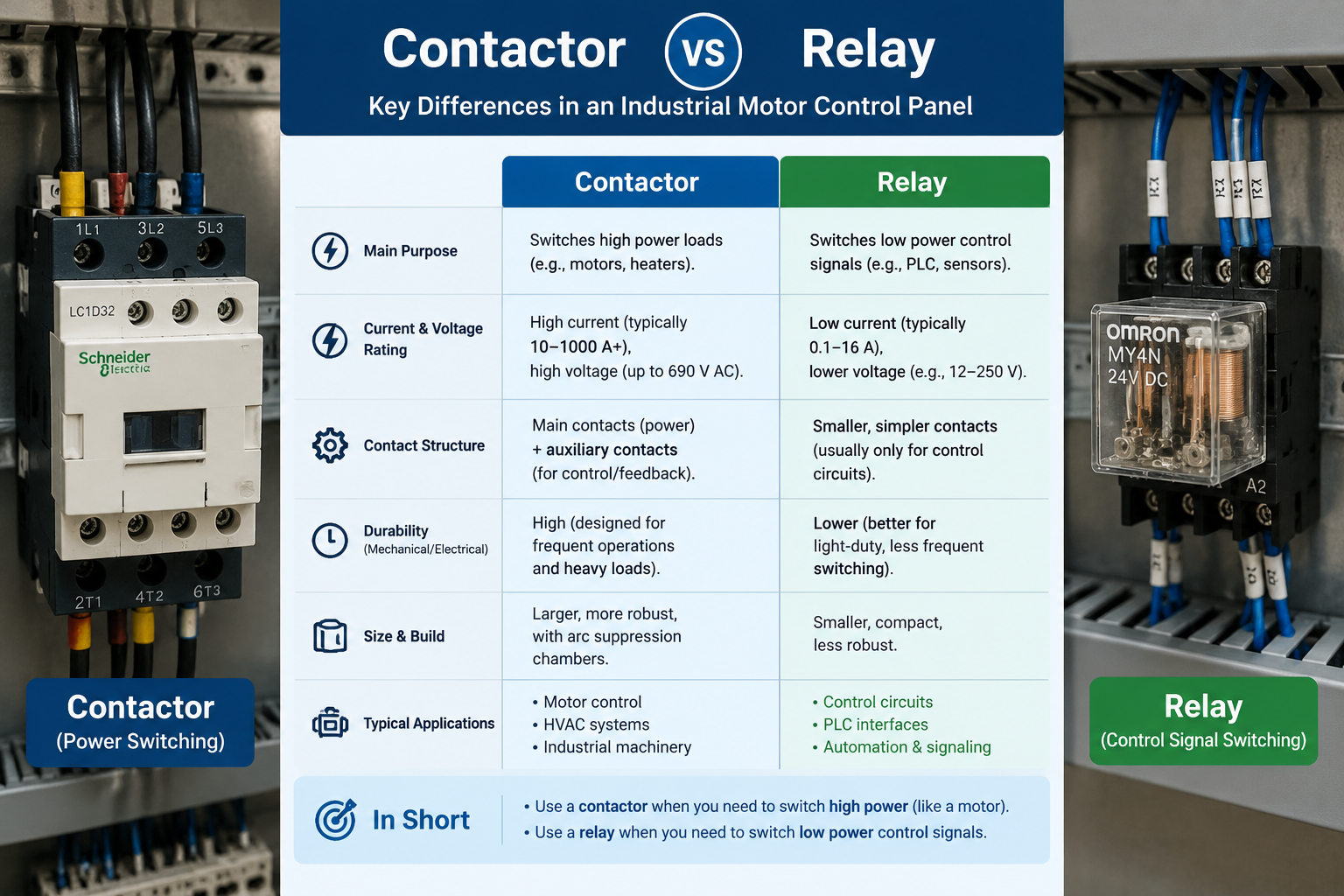
Key Takeaways
| Question | Short answer |
|---|---|
| Which handles more current? | Contactors — from tens to hundreds of amps |
| Which is built for motors? | Contactors, with arc chutes to break load current safely |
| Which is cheaper and smaller? | Relays — for signal and low-power switching |
| Can they be swapped? | Only in narrow ranges — usually no |
What Is a Relay and How Does It Work?
A relay is an electrically operated switch. A low-power signal energizes a coil; the coil’s magnetic field closes (or opens) a set of contacts. Control relays typically switch from fractions of an amp up to about 10 A, and they exist to let a small signal control a bigger one — a PLC output driving a motor contactor coil, for example, or interlocking logic between machines. Relays are small, cheap, fast, and available with multiple contact configurations.
What Is a Contactor and How Does It Work?
A contactor is a heavy-duty relay built for power circuits. It does the same electromagnetic job, but everything is scaled up and engineered for breaking load current under load:
- Higher contact ratings — tens to hundreds of amps at line voltage
- Arc chutes — split and cool the arc that forms when contacts open under load, so the circuit actually breaks instead of continuing to arc
- Robust mechanical design — rated for frequent switching and motor inrush currents many times the running current
- Three-pole standard — built to switch three-phase motors directly
Contactors are the standard front-end for motor control: combined with an overload relay they form the classic motor starter. For the wider motor-control context, see our article on what an electrical drive is.
What Is the Difference Between a Contactor and a Relay?
| Point | Relay | Contactor |
|---|---|---|
| Typical switching current | Up to ~10 A | Tens to hundreds of amps |
| Arc suppression | Minimal — not rated to break heavy load | Arc chutes designed for load breaking |
| Typical load | Signals, coils, small lamps, control circuits | Three-phase motors, heaters, power circuits |
| Physical size | Small (panel DIN rail) | Larger, with main power terminals |
| Cost | Low | Higher — power contacts are expensive to build |
| Switching frequency | Fast, frequent | Rated for frequent motor switching |
The one-line version: a relay is a control device; a contactor is a power device. Contactors also commonly pair with auxiliary contact blocks to feed status signals back into the control circuit — the two devices working together rather than competing.
Contactor vs Relay: How Do You Choose for Your Application?
Three rules of thumb cover most panel decisions:
- Switching a motor or heater above ~10 A? Use a contactor. Motor inrush will weld or pit relay contacts that were never rated for it.
- Interfacing a PLC output, sensor, or interlock? Use a relay — cheap, fast, and replaceable.
- Safety functions? Use a rated safety relay or safety contactor with forcibly guided contacts, not a standard relay. We stock units like the Schneider XPSAXE5120P safety relay module for exactly this duty.
Replacing a welded contactor or a failed relay in a running panel? Send us the catalog number and a photo of the rating plate. We will confirm the exact equivalent and have it tested before dispatch: [email protected] or WhatsApp +86 15107352558.
Can You Use a Relay Instead of a Contactor?
Occasionally, in the narrow band where ratings overlap (roughly 5–10 A resistive load), a power relay can do a contactor’s job. Outside that band, do not: breaking motor current with an unrated relay arcs the contacts, welds them shut, and leaves the motor running when it should stop. The reverse substitution — a contactor where a relay would do — works electrically but wastes money and panel space. Match the device to the load, not to what happens to be in the spares bin.
What Maintenance Do Contactors and Relays Need?
- Inspect contact surfaces — light pitting is normal; severe pitting or welded spots mean replacement
- Listen for chattering — usually low control voltage or a failing coil; it destroys contacts quickly
- Check coil voltage — control transformers sag under load; undervoltage coils overheat
- Keep them clean and dry — conductive dust across terminals causes tracking and nuisance faults
- Count operations — contactors on high-cycle machines have mechanical and electrical life ratings; plan replacement before the rating, not after
Related components follow the same discipline — our guide to choosing circuit breakers for Siemens panels covers the protection side of the same panel.
Frequently Asked Questions
What is the difference between a relay and a contactor?
Both are electromagnetic switches, but a contactor is built for high-power loads with arc chutes and heavy contacts, while a relay handles control-level currents up to about 10 A. Contactors switch motors; relays switch signals.
Is a contactor just a big relay?
Fundamentally yes, but the engineering differences matter: arc suppression, contact pressure, inrush ratings, and three-phase construction. Those features are why contactors survive motor duty that destroys relays.
How do contactors work?
A coil creates a magnetic field that pulls the main contacts closed, connecting the load to line power. Opening the coil circuit releases the contacts, and the arc chute extinguishes the arc drawn between separating contacts.
What are the main types of contactors?
The common families are AC contactors for motor starting, DC contactors for battery and DC bus applications, capacitor-switching contactors, and vacuum contactors for medium voltage. Within each, sizes are chosen by motor horsepower or full-load current.
Is it safe to buy used contactors and relays?
Yes, if the supplier tests coil operation, contact resistance, and insulation, and states the mechanical condition. Contact condition is the deciding factor — ask for it specifically.
Source Contactors, Relays, and Panel Parts
Getting the contactor vs relay choice right only helps if the right part is on the shelf. We stock 100,000+ automation parts from 20+ brands — contactors, relays, breakers, and modules included — every unit tested before dispatch, with 48-hour global shipping and no minimum order. Send the catalog number: [email protected] or WhatsApp +86 15107352558. Browse the contactors, relays, and switches category for current stock.