

Walk into most automotive, food, or packaging plants in North America and you will find an Allen-Bradley PLC running the line. The Allen-Bradley PLC benefits that matter to maintenance managers come down to three things: integration, reliability, and parts availability over the machine’s whole life. This guide explains what these PLCs do well, which family fits which application, and what to check before you buy a replacement unit.
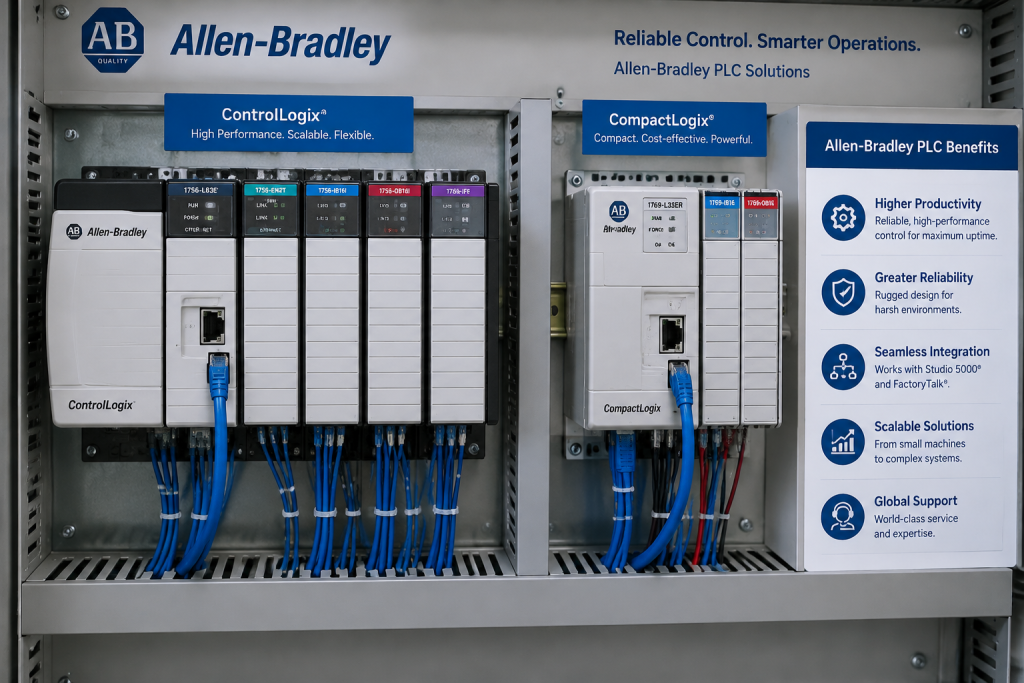
Key Takeaways
| Benefit | What it means for your plant |
|---|---|
| One programming environment | PLCs, drives, HMIs, and safety share Studio 5000 / RSLogix skills |
| Backward-compatible migrations | Old programs port forward instead of being rewritten |
| Huge installed base | Technicians, documentation, and spare parts stay easy to find |
| Integrated safety options | GuardLogix merges standard and safety control in one chassis |
What Is an Allen-Bradley PLC?
Allen-Bradley is the industrial control brand of Rockwell Automation. Its PLC range covers everything from microcontrollers for simple machines to large modular platforms that coordinate whole production lines. The real strength is the ecosystem: PLCs, PowerFlex drives, Kinetix motion, PanelView HMIs, and safety controllers that share the same software environment (Studio 5000 and RSLogix) and the same network backbone (EtherNet/IP).
What Are the Allen-Bradley PLC Benefits in Practice?
1. One software environment across the line
A ControlLogix processor, a PowerFlex drive, and a PanelView HMI are programmed and diagnosed from the same Rockwell suite. Your team maintains one skill set and one set of tools instead of four.
2. Migrations that protect your investment
Rockwell has kept generations backward-compatible for decades. Logic written for an SLC 500 in the 1990s can usually move forward to CompactLogix with modest rework. You upgrade hardware without rewriting thousands of rungs of validated logic.
3. Proven reliability in harsh plants
These controllers run in automotive welding shops, washdown food lines, and outdoor material handling. Conformal-coated variants and redundant processor options exist for the worst conditions.
4. A support network that never sleeps
The installed base is enormous. Manuals, application notes, and experienced technicians are everywhere. When a line stops at 2 a.m., someone on your team has probably seen that fault before.
5. Integrated machine safety
GuardLogix and safety I/O let safety and standard control share one chassis and network, which simplifies validation and cuts wiring on new builds.
6. Parts that stay available
A platform is only cheap to own while parts exist. Because so many Allen-Bradley systems remain in service, CPUs, I/O modules, and power supplies stay obtainable from the OEM and from independent suppliers long after a series ends. Our Allen-Bradley parts catalog shows the categories independent suppliers typically cover.
Which Industries Rely on Allen-Bradley PLCs Most?
- Automotive and tier-1 suppliers — high-speed lines with heavy I/O counts
- Food and beverage — washdown-rated hardware and recipe management
- Packaging and converting — CompactLogix paired with Kinetix servo motion
- Water, oil, and gas — remote I/O over EtherNet/IP and redundant controllers
- Pharmaceuticals — validated systems where platform stability matters
What Are the Main Allen-Bradley PLC Families?
| Family | Series | Scale | Best for |
|---|---|---|---|
| ControlLogix | 1756 | Large, plant-wide | Whole lines, redundancy, high I/O counts |
| CompactLogix | 1769 / 5069 | Machine-level | Mid-size machines, logic plus motion in one chassis |
| Micro800 | 2080 | Small | Stand-alone machines and OEM equipment |
| SLC 500 (legacy) | 1746 / 1747 | Mid-size, older | Installed base still running in many plants |
| GuardLogix | 1756-LxS | As ControlLogix | Integrated safety applications |
We regularly supply tested units across these families — for example the 1769-L32E CompactLogix processor for machine control and the 1756-IF8 analog input module for ControlLogix racks.
Are Allen-Bradley PLCs Worth the Higher Price?
They are rarely the cheapest option on a quotation. The case rests on total cost of ownership:
- Downtime cost — a failed processor costs more per hour than any brand premium. Fast diagnosis and available hardware matter most.
- Engineering cost — one software environment across PLCs, drives, and HMIs cuts training and commissioning hours.
- Lifecycle cost — backward-compatible migrations keep old programs alive instead of forcing rewrites.
For critical lines, teams that already know the platform, or plants full of Rockwell drives and HMIs, the premium is usually justified. For a simple, non-critical machine with no ecosystem ties, alternatives can make sense.
Not sure whether to repair, replace, or upgrade your Allen-Bradley CPU? Send us the catalog number and a photo of the nameplate. Our engineers will confirm compatibility before you spend anything: [email protected] or WhatsApp +86 15107352558.
What Should You Check Before Buying a Replacement Allen-Bradley PLC?
- Exact catalog match. Series, revision, firmware, and memory size all matter — a 1756-L61 and a 1756-L62 are not automatically interchangeable. Our 1756-L61 replacement guide walks through the checks.
- Condition and testing. Ask whether the unit is new, refurbished, or surplus — and whether it was powered up and output-tested before dispatch.
- Warranty terms. Independent suppliers vary; 12 months is common for tested refurbished units.
- Firmware and licensing. Some CPUs need a specific firmware revision or activation to accept your existing program.
For a fuller buying process, read our guide to sourcing Allen-Bradley replacement parts before you order.
Frequently Asked Questions
What are the main benefits of Allen-Bradley PLCs?
The most cited ones are a single programming environment across PLCs, drives, and HMIs; backward-compatible migrations; proven reliability; a huge installed base that keeps parts and expertise available; and integrated safety options.
Which is better, ControlLogix or CompactLogix?
Neither is universally better. CompactLogix fits machine-level control with moderate I/O; ControlLogix fits larger systems, redundancy, and expansion. I/O count, motion needs, and budget usually decide.
Are Allen-Bradley PLCs still made?
Yes. Rockwell Automation continues to develop the Logix platform while keeping support windows for older series such as SLC 500 and PLC-5.
Is it safe to buy refurbished Allen-Bradley PLCs?
Yes, if the supplier tests each unit under load, states the condition clearly, and provides a warranty. Verify the exact catalog number, revision, and firmware before ordering.
How long do Allen-Bradley PLCs typically last?
In typical industrial environments, 15 to 20 years is common — which is why many SLC 500 and early ControlLogix systems are still in service today.
Get Your Allen-Bradley Parts Fast
Need an Allen-Bradley PLC, module, or HMI part without the long OEM lead time? The Allen-Bradley PLC benefits your plant relies on only hold while hardware stays available — and that is where we help. We stock 100,000+ automation SKUs from 20+ brands, every unit tested before dispatch, with 48-hour global shipping and no minimum order. Send us your part number: [email protected] or WhatsApp +86 15107352558.